Phosphate and Carbonate in the Biomineralization of Chicken Eggshells and the Increase in Eggshell Thickness through Nanodroplet Addition

Phosphate and Carbonate in the Biomineralization of Chicken Eggshells and the Increase in Eggshell Thickness through Nanodroplet Addition
Valadao Cardoso, A.; Novaes Ferreira, R.; Dantas, M. S.; Rezende dos Santos, L. H.; Gomes, A. P.; de Assis, L. L.
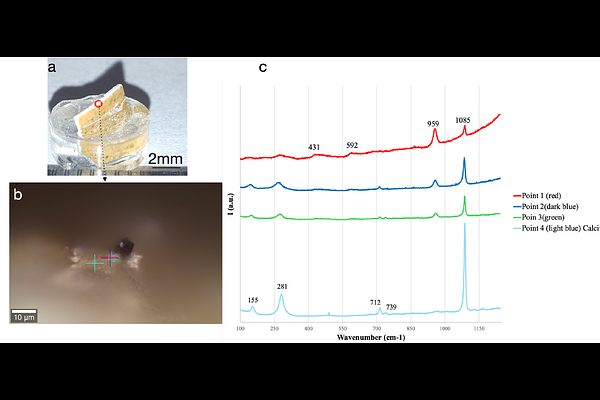
AbstractThe presence of hydroxyapatite (HAp) in the cuticle of laying hen eggshells was investigated through an extensive and detailed study combining scanning electron microscopy (SEM) coupled with energy-dispersive spectroscopy (EDS), as well as micro-Raman, micro-FTIR, X-ray diffraction (XRD), and thermogravimetric analysis (TG). Additionally, Raman and FTIR spectra of cuticle HAp were compared with those obtained from the internal surface of chicken femur fragments and from a bovine HAp sample. Examination of the same region by SEM in SE (topographic) and BSE (subsurface compositional contrast) modes revealed unidirectional (nanofibrous) calcite growth within the Vertical Layer (VL) and Palisade Layer (PL), which together constitute nearly the entire eggshell thickness. Shell thickening in the VL and PL layers appears to proceed via an additive mechanism characterized by the successive deposition of nanodroplets con-taining, according to our hypothesis, the mineral phase, water, and organic components. This multiphasic system generates lamellae that progressively increase in thickness through the continuous incorporation of new nanodroplets onto the pre-existing surface. This additive nanodroplet-mediated growth contributes to understanding how micropores form in the PL and VL. Biomineralization via an additive mechanism is strongly supported by the presence of nano-hemispheres attached to growing lamellae in the VL and PL. Statistical analyses corroborate the relationship between the diameter of cuticle nanospheres and that of nano-hemispheres in the Vertical Layer. Fractures observed in the VL indicate structural continuity between the cuticle and the Vertical Layer, suggesting that additive growth involves a continuous supply of HAp - possibly across the entire uterine surface - which, through a yet undescribed mechanism, dissolves and/or transforms calcium phosphate nanospheres into calcium carbonate nanofibers.