Life in sediments fosters 'sexual' speciation in Shewanella baltica

Life in sediments fosters 'sexual' speciation in Shewanella baltica
Fernandez-Juarez, V.; Salva-Serra, F.; Segui, G.; Martin-Rodriguez, A. J.
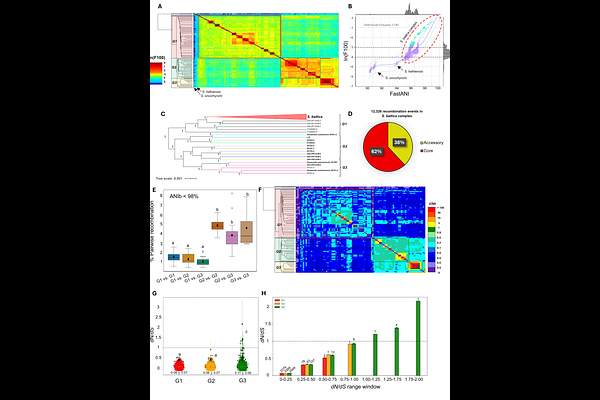
AbstractUnderstanding how intra- and interspecific differentiation arises in natural microbial populations is central to explaining the processes that drive bacterial evolution. Motivated by the co-occurrence of several genospecies closely related to Shewanella baltica in Baltic Sea sediments, we investigated the genomic structure of this species complex across fine spatial scales. Here, we analyzed 112 genome sequences spanning multiple sampling sites, comprising sympatric strains arbitrarily sampled across several cores and multiple sediment depths (0-6 cm) at Vaxon (Stockholm archipelago, Sweden), as well as earlier isolates from the same site and allopatric strains collected elsewhere in the Stockholm region from both sediment and the water column. Using a reverse-ecology population genomics approach, we found that the analyzed strains form a species complex that resolves into three cohesive evolutionary lineages (G1, G2, and G3), each defined by extensive gene turnover and distinct eco-genomic signatures largely driven by horizontal gene transfer (HGT). While G1 comprises mainly a single species, i.e., S. baltica, G2 and G3 harbor a large diversity of divergent genospecies that remain stable over time and are consistently recovered from sediment environments. Patterns of homologous recombination indicate that speciation within G2 and G3 is primarily recombination-driven ('sexual'), with both groups deriving from a common ancestor. Our results capture a snapshot of early-stage speciation within a shared ecosystem and shed light on the mechanisms that diversify sympatric, recombining bacterial populations, with a sediment-associated lifestyle apparently stimulating this process.