MHC-II acts as a fusion-triggering receptor for bat influenza virus

MHC-II acts as a fusion-triggering receptor for bat influenza virus
Peterl, S.; Robert, J.; Osman, M. K.; Haines, R. A.; Fischer, K.; Langi, R. E.; Ciminski, K.; Schwemmle, M.; Reuther, P.; Chlanda, P.
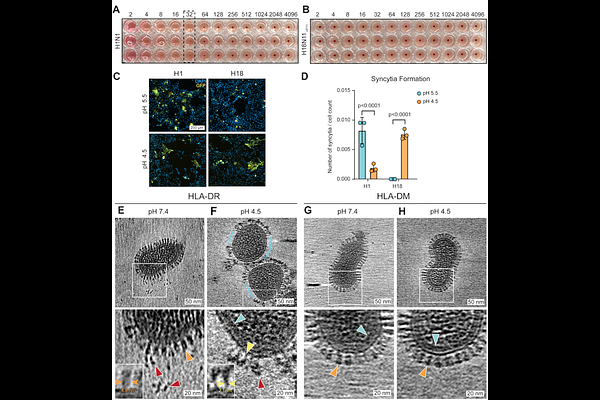
AbstractInfluenza A virus hemagglutinin is a prototypical class I viral fusion protein that binds sialylated glycans and is activated by low pH in endosomes. In contrast, bat-derived IAV subtypes H17N10 and H18N11 use major histocompatibility complex class II (MHC-II) as an entry receptor, but how this receptor contributes to membrane fusion remains unknown. We find that MHC-II-dependent hemagglutinin subtypes H17, H18, and H19 possess an increased negative net charge relative to canonical HAs. Using cryo-electron tomography, we demonstrate that H18N11 morphology remains stable and H18 is in prefusion conformation at strongly acidic pH. Remarkably, H18 undergoes fusion-relevant conformational changes only when both MHC-II binding and low pH are present. By reconstitution of H18N11 fusion with liposomes and purified MHC-II, we show that receptor engagement is required to trigger the fusion activity of H18. These findings identify MHC-II as a receptor that directly triggers membrane fusion and reveal a previously unrecognized receptor-dependent mechanism of influenza virus entry.