Disentangling the Relationship Between Mind Wandering and Symptom Dimensions in a Non-Clinical Sample: ADHD as the Primary Driver

Disentangling the Relationship Between Mind Wandering and Symptom Dimensions in a Non-Clinical Sample: ADHD as the Primary Driver
Likar, M.; Brezoczki, B.; Vekony, T.; Simor, P.; Nemeth, D.
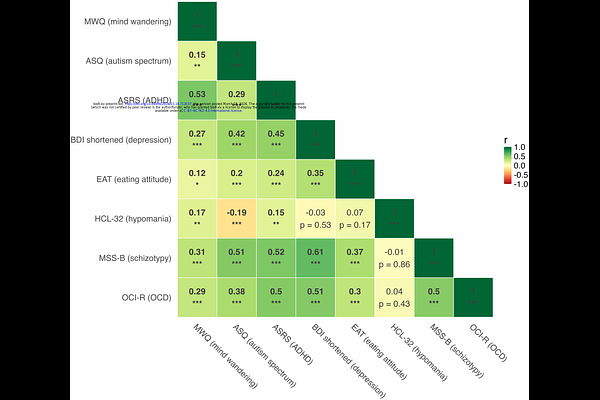
AbstractMind wandering has been linked to a wide range of psychiatric conditions, yet most studies have examined these associations in isolation. Given the substantial comorbidity across the psychopathological spectrum, it remains unclear whether elevated mind wandering reflects a general marker of psychopathology or a more specific attentional-control deficit shared across symptom dimensions. To address this, we adopted a dimensional, transdiagnostic approach in a non-clinical sample (N = 376), simultaneously modeling seven symptom dimensions: ADHD, depression, obsessive-compulsive tendencies, schizotypy, autistic traits, hypomania, and eating disorder symptoms. At the bivariate level, mind wandering correlated positively with all symptom dimensions. However, when the substantial shared variance across dimensions was accounted for in both frequentist and Bayesian multivariate regression models, only ADHD symptoms emerged as a unique predictor ({beta} = 0.53; BF > 1000), with all remaining predictors yielding negligible unique contributions and Bayes factors supporting the null hypothesis. These findings suggest that previously reported associations between mind wandering and diverse psychopathological symptom dimensions largely reflect a shared liability with ADHD-related attentional dysregulation, rather than disorder-specific mechanisms. This positions mind wandering as a marker of attentional dysregulation more closely tied to ADHD symptomatology than to general psychopathological burden.