A central somatotopic map of the fly leg supports spatially targeted grooming

A central somatotopic map of the fly leg supports spatially targeted grooming
Elabbady, L.; Chou, G.; Sustar, A.; Cook, A. P.; Collman, F. C.; Tuthill, J. C.
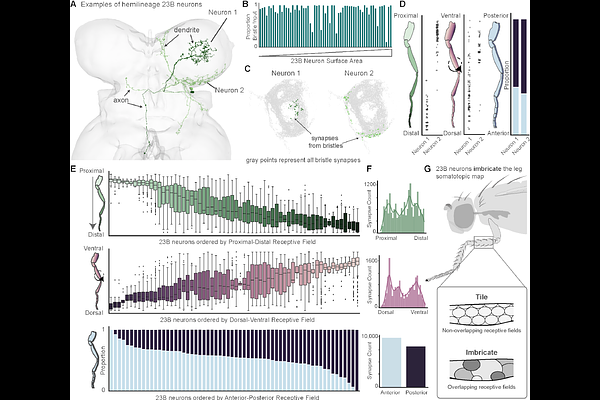
AbstractAnimals continuously monitor their body surfaces to detect and remove debris or parasites. Effective grooming requires that tactile inputs from specific body regions be converted into precisely targeted motor actions, but the neural circuits that support this sensorimotor transformation remain poorly understood. Here, we combine genetic tools and connectomics to elucidate a central somatotopic map of the Drosophila leg. We show that the axonal projections of leg touch receptors within the fly's ventral nerve cord (VNC) are organized along the same cardinal axes as the developing leg. Somatotopically organized bristle axons target a specific class of developmentally-related local interneurons, which imbricate the leg map with overlapping receptive fields of different shapes and sizes. These second-order interneurons target distinct pools of premotor interneurons, which in turn synapse directly onto motor neurons that control leg muscles. Optogenetic activation of second-order interneurons elicits spatially targeted grooming of specific leg regions, consistent with our spatial receptive field predictions based on the connectome. Together, our results suggest that this four-layer circuit processes spatial information from a somatotopic map of the fly leg to guide targeted grooming behavior.