Design and Implementation of a Microservice-Architecture Master Control System for AIMS

Design and Implementation of a Microservice-Architecture Master Control System for AIMS
Li-Yue Tong, Jia-Ben Lin, Jun-Feng Hou, Yuan-Yong Deng, Dong-Guang Wang, Guang-Qian Liu, Song-Bo Xu, Shang-Jie Ren, Lian-Wei Zhao, Zhi-Wei Feng, Wei Duan, Ming-Fu Shao, Hui Wang, Chen Yang
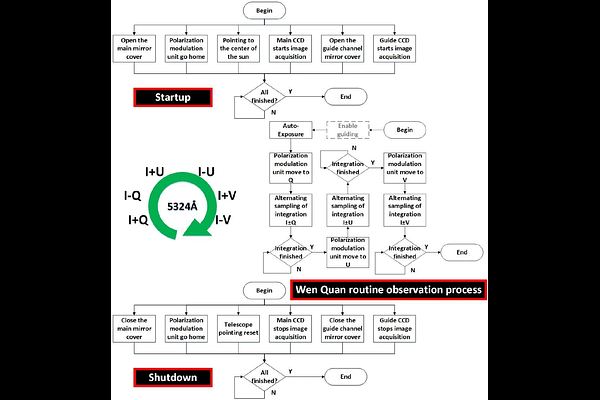
AbstractThe mid-infrared solar magnetic field telescope AIMS (An Infrared System for the Accurate Measurement of Solar Magnetic Field) is the first ground-based telescope designed to directly measure solar magnetic fields via Zeeman splitting in the 8-14 um band, overcoming the century-long bottleneck of model-dependent indirect measurements. Its remote high-altitude site, heterogeneous multi-institute components, and complex observation modes comprising Fourier Transform Infrared (FTIR) spectropolarimetry and broadband imaging demand a highly autonomous Master Control System (MCS). We present the design and implementation of the AIMS MCS, featuring three key contributions: (1) an L0-L5 telescope automation classification inspired by the SAE J3016 autonomous driving standard, providing well-defined boundaries and a progressive evolution roadmap; (2) a three-layer system framework device control, autonomy support, and central decision-implemented with a microservice software architecture that achieves loose coupling, high cohesion, and continuous integration of heterogeneous components; and (3) a suite of key enabling tech-nologies including automatic pointing/tracking, autofocus via lucky-frame selection combined with power spectral ratio analysis, and environment-adaptive observation integrating auto-exposure, cloud detection, and power/thermal monitoring. The MCS has been validated across three telescopes at progressive automation levels: AIMS itself, the WenQuan Solar Magnetic Field Telescope, and the Solar Full-disk Multi-layer Magnetograph (SFMM). Collectively, these deployments demonstrate the feasibility and stability of the proposed architecture for progressive telescope automation.