Altering dosage of meiotic crossover-associated RING finger proteins affects crossover number and interference in Drosophila

Altering dosage of meiotic crossover-associated RING finger proteins affects crossover number and interference in Drosophila
Frantz, E.; Santa Rosa, P.; McMahan, S.; Sekelsky, J.
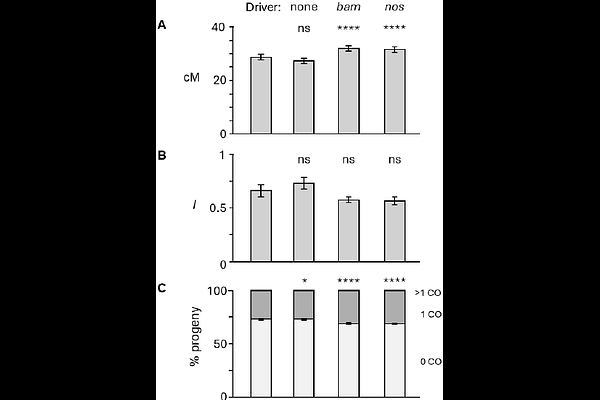
AbstractCrossovers play a critical role in ensuring correct reductional segregation of homologous chromosomes in the first meiotic division. Crossing over is initiated by formation of DNA double-strand breaks (DSBs), but the number of DSBs is greater than the number of crossovers. Which recombination sites become crossovers, versus being repaired as non-crossovers, is not random, but is subject to several crossover patterning phenomena, including crossover assurance and crossover interference. One current model for crossover designation proposes that crossover-associated RING finger proteins (CORs) undergo the biophysical process of coarsening, in which larger accumulations continue to get larger and smaller accumulations go away. Genetic and cytological studies of the three CORs in Drosophila melanogaster, Vilya, Narya, and Nenya, are consistent with this model. In females heterozygous for a deletion of vilya, fewer double-crossovers are observed. Conversely, crossovers are elevated in females carrying a duplication of vilya and in females coordinately overexpressing Vilya, Narya, and Nenya. These findings support a model in which crossover designation occurs through coarsening of COR proteins within the synaptonemal complex.