Little Red Dots on FIRE: Exploring the formation and observational signatures of ultra-compact early galaxies

Little Red Dots on FIRE: Exploring the formation and observational signatures of ultra-compact early galaxies
Niranjan Chandra Roy, Daniel Anglés-Alcázar, Rachel K. Cochrane, Alexander J. Richings, Jonathan Mercedes-Feliz, Christopher C. Hayward, Claude-André Faucher-Giguère, Erini Lambrides, Robert Feldmann, Boon Kiat Oh, Andrew Marszewski, Guochao Sun, Kelcey Davis, Jed McKinney, Caitlin M. Casey, Tanio Díaz-Santos, Madisyn Brooks, Grace Farrell
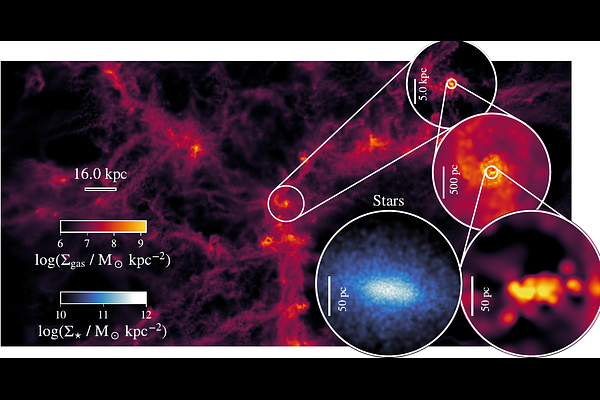
AbstractLittle Red Dots (LRDs) are compact sources with broad Balmer lines, Balmer breaks, anomalous UV emission, rising red continuum, and uncertain origin. We use FIRE cosmological simulations, 3D dust radiative transfer, and synthetic emission-line data cubes to test whether ultra-compact early galaxies can reproduce LRD-like observables without invoking AGN. In progenitors of present-day group halos ($M_{\rm halo} > 10^{13.5} M_{\odot}$), we identify transient phases at $z \approx 4-8$ lasting $\sim 150-400$ Myr in which strong dissipative inflows build massive ($M_{\star} \sim 10^{8.5}-10^{10.5} M_{\odot}$), UV-bright ($-23 \lesssim M_{\rm UV} \lesssim -20$), ultra-compact ($R_{\rm eff} < 300$ pc) stellar cores with extreme circular velocity ($V_{\rm circ} > 500$ km s$^{-1}$) and consistent with several LRD properties: strong Balmer breaks ($F_ν(4200{\rm Å})/F_ν(3500{\rm Å}) \sim 2$); blue UV beta slopes ($β_{\rm UV} \approx -1.25$); dust masses; ALMA non-detections; and Balmer-line widths up to $\sim 1500$ km s$^{-1}$ broadened by galaxy-scale dynamics. However, stellar emission and host-galaxy kinematics alone do not reproduce the red rest-optical continuum, more extreme Balmer breaks ($\gtrsim 2.5$) and line widths ($\gtrsim 2000$ km s$^{-1}$), or the broad-Balmer/narrow-forbidden-line signature of broad-line AGN. The same ultra-compact conditions efficiently fuel central BHs, suggesting a hybrid stellar+AGN scenario in which compact stars explain the UV continuum, Balmer break, and intermediate line widths while AGN supply the red optical continuum and more extreme line properties. With halo masses $M_{\rm halo} \sim 10^{11-12.5} M_\odot$ and comoving abundance $\sim 2 \times 10^{-5} {\rm cMpc}^{-3}$ (for $\sim 20\%$ duty-cycle at $z \approx 4-8$), ultra-compact galaxies can contribute to the massive, bright LRD population.