Non-ribosomal Peptides as Structural Determinants of Fungal Hydrophobicity

Non-ribosomal Peptides as Structural Determinants of Fungal Hydrophobicity
Aalborg, T.; Westphal, K. R.; Delenyi, B.; Lunden, T. L.; Joergensen, M. O.; Tolmachev, D.; Soerensen, T.; Sammalkorpi, M.; Soerensen, J. L.; Kristensen, P.; Linder, M. B.; Wimmer, R.; Sondergaard, T. E.
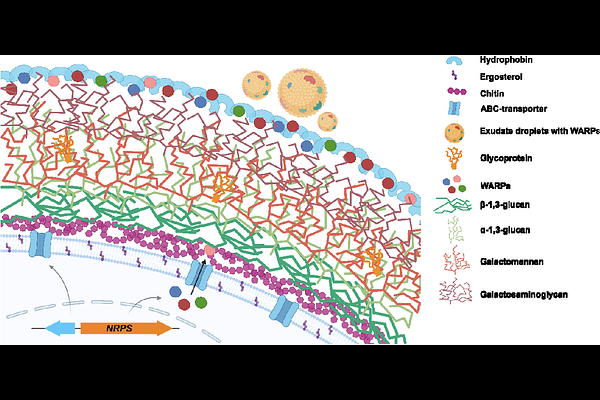
AbstractFungal surfaces must remain hydrophobic to enable growth, dispersal, and survival under fluctuating environmental conditions, yet the molecular basis of this property remains incompletely understood. Here, we identify fungisporins, fusahexins, and related cyclic non-ribosomal peptides (NRPs) as members of a conserved functional class of fungal metabolites, termed WAter Repellent Peptides (WARPs), that are required for fungal surface hydrophobicity. Across filamentous fungi, WARPs vary substantially in sequence and length but share conserved structural features, including cyclization, hydrophobic amino acid composition, and alternating D- and L-configurations, consistent with a flexible amphiphilic scaffold. Loss of WARP-producing non-ribosomal peptide synthetases results in rapid collapse of aerial hyphae upon water exposure, demonstrating that these peptides are required for maintenance of hydrophobic aerial structures. Using phage-display-derived antibodies, we localize WARPs to the hyphal surface, supporting their role as surface-associated structural components. Together, these findings identify a conserved NRPS-encoded peptide system that contributes to fungal hydrophobicity and establish WARPs as a broadly distributed class of surface-associated metabolites with structural function in filamentous fungi.