Stellar feedback SPICEs up [C II] emission in the first galaxies

Stellar feedback SPICEs up [C II] emission in the first galaxies
Aniket Bhagwat, Tiago Costa, Benedetta Ciardi, Fabrizio Arrigoni Battaia
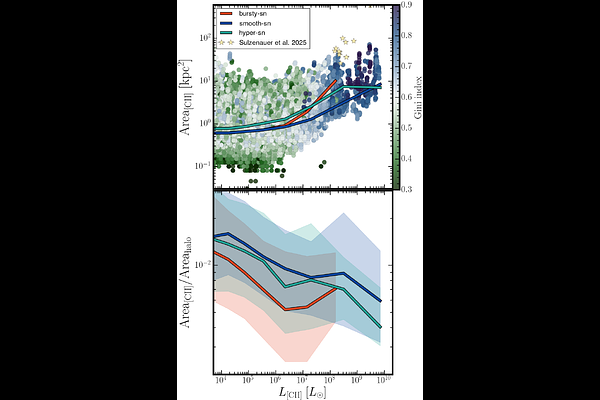
AbstractThe bright [C II] 158 $μ$m line is a key tracer of star-forming gas and feedback-driven outflows in high-redshift galaxies. Using the {\tt SPICE} simulations, we quantify how variations in stellar feedback (bursty versus continuous energy injection) shape properties of $z \gtrsim 5$ galaxies traced by [C II] emission. All models show a tight correlation between [C II] luminosity ($L_{\rm [CII]}$) and star formation rate, but bursty feedback produces systematically lower $L_{\rm [CII]}$ at fixed star formation rate and larger intrinsic scatter. The [C II]-emitting region is typically more extended than the rest-frame UV continuum by factors of $\approx 2-4$, consistent with ALMA observations at $z>5$. Outflowing gas is ubiquitous, with mass outflow rates scaling with $L_{\rm [CII]}$ and reaching $\sim 10,M_\odot,{\rm yr^{-1}}$, yet net mass flux remains inflow-dominated in [C II]-bright galaxies, even with bursty feedback. We find that outflow velocities inferred from [C II] line profiles overestimate true cold gas outflow velocities by factors of 2--3 while underestimating net gas outflow velocities by factors of 2--5, indicating that [C II] is a biased tracer of gas flows. Although outflows are present in all models, the fastest gas is not [C II]-bright; the brightest high-velocity [C II] emission can be explained by gravitational motion. While [C II] spatial and spectral properties alone do not clearly distinguish feedback models, gas kinematics provides a strong diagnostic: predicted $V/σ$ ratios show that smooth feedback enables earlier disk settling in massive galaxies, whereas bursty feedback delays disk formation, yielding a higher disk fraction ($\approx 48%$ vs.\ $\approx 28%$) at $z=5$. Overall, [C II] reliably traces star formation but, when used alone, misrepresents gas kinematics, underscoring the need for multiwavelength (ALMA+JWST) diagnostics.