Time cells differentially populate trace and post-trace epochs, but do not remap for different trace intervals

Time cells differentially populate trace and post-trace epochs, but do not remap for different trace intervals
Nambisan, H. S.; Bhalla, U. S.
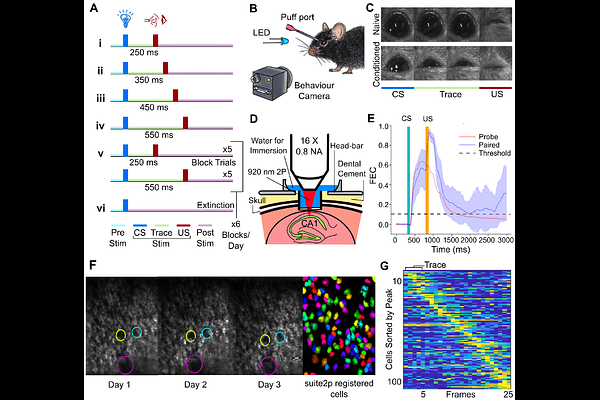
AbstractHippocampal time cells are a neural substrate for linking discontiguous events in time. While they have been reported both for working memory tasks (~15 s) and trace-eyeblink conditioning (TEC, ~300 ms), the latter is ~50-fold faster and requires pre-emptive and precisely timed responses. We therefore asked if novel features of time-cell rescaling, post-stimulus activity, and time-cell extinction might arise in TEC. We used 2-photon calcium-sensor imaging from mouse hippocampal CA1 pyramidal neurons during TEC tasks with varying intervals, and specifically included a protocol in which short blocks of 250 and 550ms trials were alternated to eliminate learning-dependent rescaling. We find that conditioned stimulus (CS) triggered traces extend for >5 seconds after the unconditioned stimulus (US), and the trials can be subdivided into epochs with distinct proportions of time cells and time-cell peak widths. Instead of remapping, the time-cell sequence is the same between 250 and 550ms intervals. CS-triggered time cells are present before trace learning, but are nearly lost after behavioural extinction, suggesting that their removal is an active process. We propose that in TEC, salient stimuli initiate time-cell sequences which are independent of subsequent timing or even absence of US, but can be gated off during extinction.