A Regionally Inspired West Virginia Obesogenic Diet Induces Fat Accretion and Metabolic Dysfunction While Identifying Sex Disparity

A Regionally Inspired West Virginia Obesogenic Diet Induces Fat Accretion and Metabolic Dysfunction While Identifying Sex Disparity
Kelley, E. E.; Giromini, A. P.; Maxwell, B. A.; Spears, A. L.; Lewis, S. E.; Salvatore, S. R.; Fazzari, M.; Balaji, S.; Fagone, P.; Konopa, E. A.; Saporito, D. C.; King, J. A.; Schopfer, F. J.; Khoo, N. K.; McCarthy, P.; Hollander, J. M.; Leonardi, R.
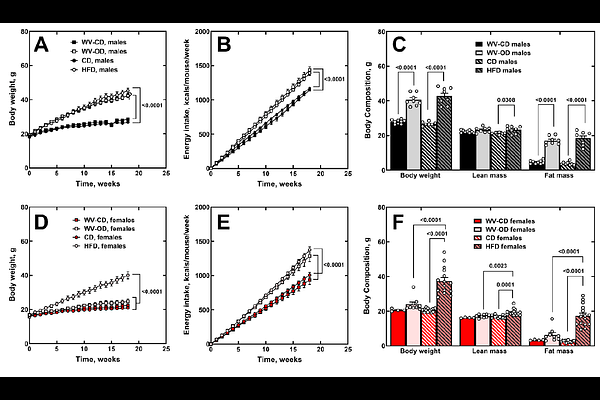
AbstractObesity prevalence continues to rise in the United States, with a disproportionate burden falling to West Virginia. To investigate the metabolic effects of region-specific dietary patterns, we developed the West Virginia Obesogenic Diet (WV-OD), a compositionally defined rodent diet based on nutritional analyses of meals consumed by obese individuals in the state. The WV-OD closely mirrors the macronutrient profile of the average American diet while incorporating regional features such as a greater sodium level and significantly less fiber. We compared the metabolic effects of the WV-OD to a matched control diet (WV-CD) and to a widely used high-fat diet (HFD, 60% of calories derived from fat) in male and female C57BL/6J mice. After 19 weeks, WV-OD-fed males exhibited weight gain and adiposity comparable to HFD-fed counterparts, along with glucose intolerance and hepatic triglyceride accumulation confirming the obesogenic and metabolically disruptive properties of the WV-OD. Unlike HFD-fed mice, WV-OD-fed males also displayed elevated circulating cholesterol and cholesterol esters without corresponding increases in hepatic total cholesterol. When compared to the HFD, the WV-OD did not increase uric acid or xanthine oxidoreductase (XOR) content of liver or circulation; however, both males and females on the WV-OD demonstrated trends towards elevated plasma uric acid. Interestingly, while exhibiting a similar caloric intake on either diet, the WV-OD females did not demonstrate significant fat accretion or metabolic dysfunction compared to females subjected to the 60% HFD. In toto, these findings: 1) establish the WV-OD as a regionally-grounded, yet broadly representative tool for modeling diet-induced obesity and metabolic dysfunction, 2) offer a physiologically relevant alternative to extreme-fat dietary models in preclinical research and 3) highlight sex-based differences in response to diet-induced obesity.