Diffractive scanning live volumetric two-photon microscopy within the contracting mouse intestine

Diffractive scanning live volumetric two-photon microscopy within the contracting mouse intestine
Jurkevicius, J.; Alata, M.; Wiggert, M.; Rixius, M.; Reinhards, S.; Thielking, M.; Stock, C.; Favre, A.; Fung, C.; Theissen-Kunde, D.; Bonacina, L.; Karpf, S.; Vanden Berghe, P.
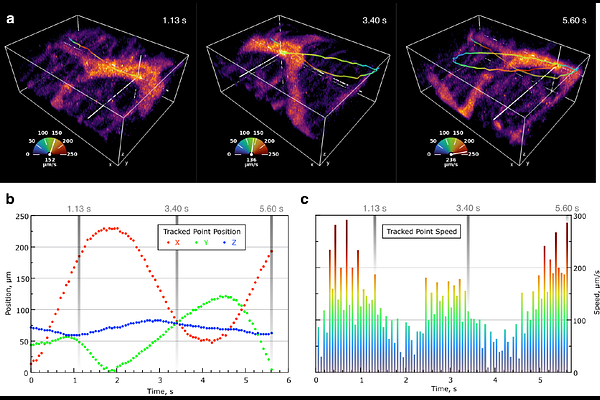
AbstractObtaining structural information from the enteric nervous system (ENS) within intact intestinal tissue requires microscopy systems capable of imaging through multiple tissue layers and during ongoing physiological motion. Tissue opacity, three-dimensional geometry, and spontaneous contractions strongly constrain volumetric imaging, limiting the applicability of most conventional linear optical techniques to imaging in either dissected, stretched or pharmacologically suppressed tissues. We apply Spectro-temporal Laser Imaging by Diffracted Excitation (SLIDE) microscopy, a diffraction-based scanning approach enabling fast volumetric two-photon imaging, to record the ENS in an intact ex vivo intestinal preparation from a transgenic mouse line expressing the red fluorescent protein TdTomato in peripheral and enteric neurons and glia. We achieved fast volumetric imaging during spontaneous contractions, capable of resolving micrometer-scale displacements in three dimensions, without inducing observable photodamage or compromising tissue viability over the experimental timescale. This work establishes 4D-SLIDE microscopy as a robust experimental framework for visualizing enteric neural structures within their native three-dimensional context during physiological motion, with direct relevance for conditions involving altered intestinal mechanics. JJ, MA, MW contributed equally; LB, SK and PVB share senior and corresponding authorship.