Integrating Electrical Components into a Printed Self-folding Cuff Electrode for Chronic Peripheral Nerve Interfaces

Integrating Electrical Components into a Printed Self-folding Cuff Electrode for Chronic Peripheral Nerve Interfaces
Hiendlmeier, L.; Tuezuen, D.; Tillert, H.; Dalichau, A.; Oetztuerk, M.; Guenzel, Y.; Zurita, F.; Al Boustani, G.; Zariffa, J.; Couzin-Fuchs, E.; Malliaras, G. G.; Guemes, A.; Wolfrum, B.
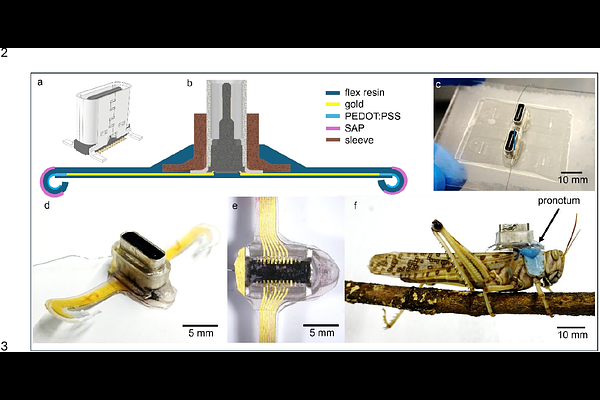
AbstractNeuroelectronic thin-film implants hold promise for advancing fundamental understanding of the peripheral nervous system and offer potential for targeted treatments using specific stimulation. However, challenges in establishing robust and durable connections to soft and flexible implants limit their widespread adoption and long-term utility. Here, we present a novel method for integrating rigid electrical components, such as a standard USB-C connector, directly into a printed stretchable self-folding cuff electrode for chronic peripheral nerve interfacing. Our multi-material printing approach provides a gradual stiffness transition, effectively mitigating common failure points associated with mechanical stress at soft-rigid boundary. We demonstrate the integration of a wireless stimulation circuit and a robust USB-C implantable port, offering a 'plug-and-play' solution for stable chronic electrophysiology experiments. Chronic implant studies in free-running locusts with USB-C connectors show reliable nerve recordings, capturing behavioral differences. The concept is further validated as a transcutaneous implanted port in rats for vagus nerve recordings. This work addresses a critical bottleneck in neurotechnology by enabling robust connectivity for implanted devices, which is essential for advancing peripheral nervous electrophysiology experiments in freely moving small vertebrates and insects.