SMART-NeuroDx: A Reagent-Free Multianalyte Biosensor Platform with Machine-Learning Readout for Point-of-Care Dementia Screening

SMART-NeuroDx: A Reagent-Free Multianalyte Biosensor Platform with Machine-Learning Readout for Point-of-Care Dementia Screening
Deshpande, S.; Pawlak, K.; Prathap, M. B.; Evans, C.; Al-Alam, T.; Joy, A. M.; Arjun, A. M.; Sharma, S.
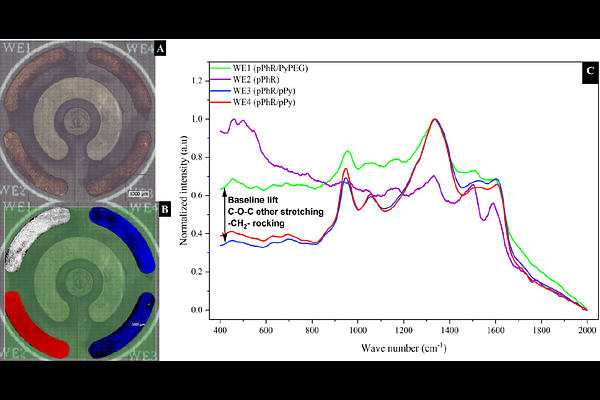
AbstractDifferentiating overlapping dementia pathologies, such as frontotemporal dementia and Alzheimer's disease, calls for the simultaneous measurement of several blood biomarkers, yet electrochemical sensors remain predominantly single-target and dependent on labels and sample preparation. Here we report SMART-NeuroDx, a reagent-free electrochemical array that quantifies pTau217, GFAP, pTau181, and NfL directly from unprocessed plasma and serum in under 35 minutes. Four surface-confined redox-active molecularly imprinted polymer and aptamer-MIP recognition matrices are electropolymerized onto a four-working-electrode porous-gold printed-circuit array, using potential-assisted electrostatic gating keyed to each target's isoelectric point to prevent cross-channel template contamination during synthesis. Label-free Faradaic responses from the redox-active polymer backbone are acquired on a custom battery-powered STM32G4 handheld potentiostat and converted to concentration from five voltammetric features using cross-validated Random Forest and XGBoost regressors. The handheld unit reproduced the baseline fidelity of a commercial benchtop workstation and resolved sub-picogram pTau217 (limit of detection 0.087 pg/ mL) across marker-appropriate dynamic ranges, with inter-chip relative standard deviation at or below 5.34% and coefficients of determination of 0.94 to 0.99 against reference concentrations. Each channel retained selectivity in plasma and serum against competing neurological and inflammatory proteins, with non-specific signal deviation held below 10% by the hydrated PyPEG interfacial shell. The platform establishes reagent-free, simultaneous four-analyte neurodegeneration sensing on a single point-of-care device.