Small-Scale and Transient EUV Kernels in Solar Flare Ribbons

Small-Scale and Transient EUV Kernels in Solar Flare Ribbons
Hannah Collier, Säm Krucker, Laura A. Hayes, Emil Kraaikamp, David Berghmans, Daniel F. Ryan
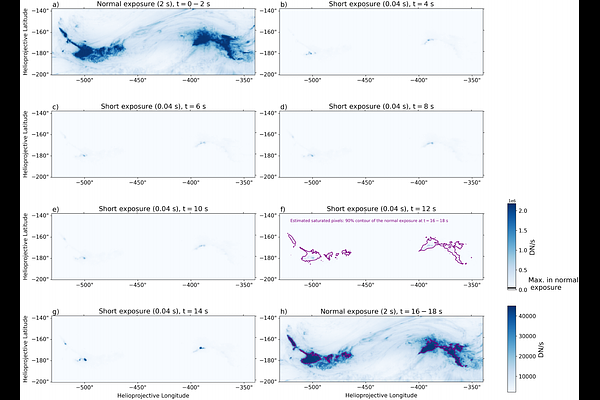
AbstractFlare ribbons form when energy released by coronal magnetic reconnection is deposited in the low solar atmosphere, so by studying the dynamics of flare ribbons, one obtains an indirect measurement of reconnection. Our aim is to quantify the spatial and temporal scales of substructures in the Extreme Ultraviolet (EUV) flare ribbons, known as kernels, as a probe of the spatial extent and duration of energy injection during the impulsive phase of solar flares. Unprecedented observations of an M2.5 GOES-class flare from the March 2024 major flare campaign of Solar Orbiter were used. These data were obtained at high-cadence in short-exposure mode with the Extreme Ultraviolet Imager's high-resolution telescope, HRI_EUV. Individual kernels were automatically identified using a classical computer vision algorithm. Size distributions of ribbon kernels were derived, and an average light curve of individual kernels was extracted. The EUV flare kernels were small ($\lesssim 60~\text{pixels} \approx 1~\text{Mm}^2$) and a significant fraction were unresolved at a plate scale of 135 km/pix. Furthermore, we derived surprisingly short EUV kernel heating times of less than a few seconds. The average profile exhibits a sharp rise of $1.7\pm0.3$ s from half-maximum, requiring an additional $2.3^{+0.7}_{-0.4}$ s to return to its reference value. Our findings indicate that approximately half of the kernels were unresolved in this flare, despite the enhanced angular resolution offered by Solar Orbiter's proximity to the Sun at 0.38 AU here. Furthermore, we show that energy was only injected in a localised region ($\lesssim 1~\text{Mm}^2$) of flare ribbons for less than a few seconds. These results necessitate an in-depth investigation into the implications of such small-scale and transient injections on the energy flux deposited in solar flares, and the resulting response of the solar atmosphere.