Multilocus microsatellite typing (MLMT) reveals high genetic diversity of Leishmania infantum strains causing tegumentary leishmaniasis in northern Italy

Multilocus microsatellite typing (MLMT) reveals high genetic diversity of Leishmania infantum strains causing tegumentary leishmaniasis in northern Italy
Rugna, G.; Carra, E.; Calzolari, M.; Bergamini, F.; Rabitti, A.; Gritti, T.; Ortalli, M.; Lazzarotto, T.; Gaspari, V.; Castelli, G.; Bruno, F.; Späth, G. F.; Varani, S.
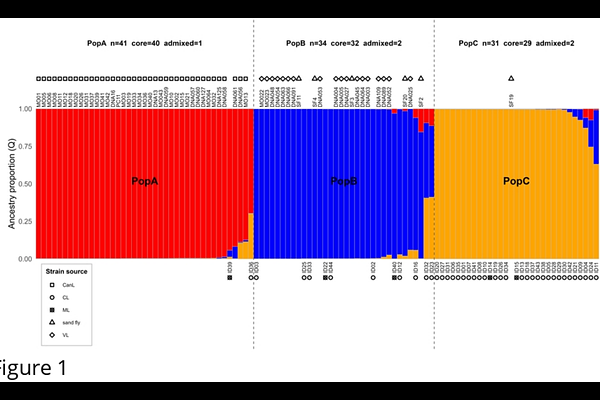
AbstractBackground Tegumentary leishmaniasis (TL) caused by Leishmania infantum has re-emerged in northern Italy, raising questions about the genetic diversity and population structure of circulating parasites and their potential role in shaping different clinical outcomes. Methodology/Principal findings Multilocus microsatellite typing (MLMT) based on 15 polymorphic loci was applied to 44 L. infantum strains obtained from TL cases diagnosed between 2013 and 2024 in the Emilia-Romagna region. These strains were compared with sympatric isolates from VL cases, dogs and sand flies. MLMT revealed a considerable genetic variation among TL-associated strains, with 43 distinct multilocus genotypes identified. Population structure analyses using Bayesian clustering, multivariate approaches and phylogenetic reconstruction consistently identified three highly differentiated genetic populations (Fst >0.25). TL strains were divided into two main populations: one shared with VL-associated strains (PopB; 9/44) and a second population found exclusively among TL cases (PopC; 28/44). In contrast, the canine-associated population (PopA) showed no overlap with TL cases in this region. Populations also displayed divergent heterozygosity patterns, as indicated by positive and negative Fis values. Conclusions/Significance These findings revealed previously unknown diversity within L. infantum in the study area and demonstrated that inclusion of tegumentary strains is essential to uncover hidden components of parasite population structure. The identification of a TL-associated population supports the existence of multiple evolutionary pathways and emphasises the importance of integrated One Health surveillance, which combines data from humans, animal hosts and vectors to improve understanding of the epidemiology of leishmaniasis in Italy.