On the Exoplanet Yield of Gaia Astrometry

On the Exoplanet Yield of Gaia Astrometry
Caleb Lammers, Joshua N. Winn
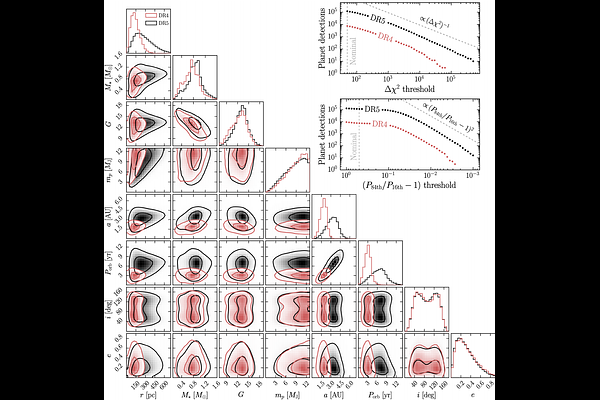
AbstractWe re-examine the expected yield of Gaia astrometric planet detections using updated models for giant-planet occurrence, the local stellar population, and Gaia's demonstrated astrometric precision. Our analysis combines a semi-analytic model that clarifies key scaling relations with more realistic Monte Carlo simulations. We predict $7{,}500 \pm 2{,}100$ planet discoveries in the 5-year dataset (DR4) and $120{,}000 \pm 22{,}000$ over the full 10-year mission (DR5), with the dominant error arising from uncertainties in giant-planet occurrence. We evaluate the sensitivity of these forecasts to the detection threshold and the desired precision for measurements of planet masses and orbital parameters. Roughly $1{,}900 \pm 540$ planets in DR4 and $38{,}000 \pm 7{,}300$ planets in DR5 should have masses and orbital periods determined to better than $20$%. Most detections will be super-Jupiters ($3$ - $13 M_{\rm J}$) on $2$ - $5$AU orbits around GKM-type stars ($0.4$ - $1.3 M_\odot$) within $500$ pc. Unresolved binary stars will lead to spurious planet detections, but we estimate that genuine planets will outnumber them by a factor of $5$ or more. An exception is planets around M-dwarfs with $a < 1$AU, for which the false-positive rate is expected to be about $50$%. To support community preparation for upcoming data releases, we provide mock catalogs of Gaia exoplanets and planet-impostor binaries.