The structure and evolution of the Galactic high-$α$ disc I. Chemical and age orbital cartography

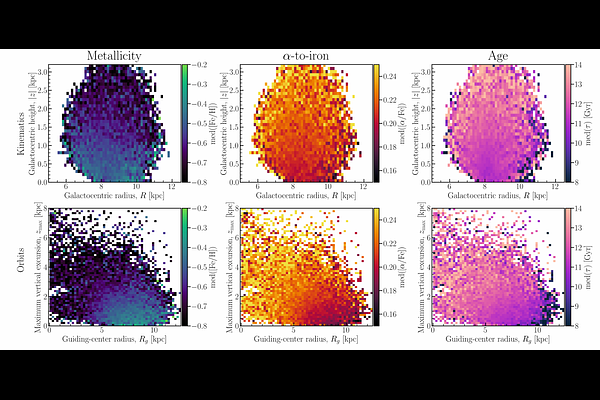
The structure and evolution of the Galactic high-$α$ disc I. Chemical and age orbital cartography
Furkan Akbaba, Danny Horta, Olcay Plevne
AbstractWe present a comprehensive chemical and age orbital cartography of the Galactic high-$α$ disc using subgiant stars with precise ages, element abundances, and full phase-space information from the \textsl{LAMOST--Gaia} data set. Specifically, we map how average [Fe/H], [$α$/Fe], and age vary across present-day kinematic and orbital coordinates. We analyse the data in full and across mono-abundance populations to measure element abundance-orbital and age-orbital gradients across orbital actions and angular-momenta. Our results show that the high-$α$ disc exhibits clear and coherent gradients in [Fe/H], [$α$/Fe], and age with orbits; these gradients are much stronger and sharper in orbital space than in present-day kinematics, showing that orbital diagnostics recover the intrinsic disc structure of old disc populations more effectively than instantaneous kinematic coordinates. We find that older high-$α$ populations display qualitatively similar element abundance--orbital and age--orbital trends to stars in the low-$α$ disc, although the high-$α$ gradients are generally shallower. The presence of these ordered correlations indicates that the old high-$α$ disc is structured, and preserved a strong fossil record of its early assembly despite the Milky Way's subsequent accretion history. This result implies that later mergers did not fully erase the chemical-orbital and age-orbital structure imprinted during the high-$α$ disc's earliest formation epoch. All together, these findings indicate that the Galactic high-$α$ disc formed mainly through inside-out and upside-down growth.