Magnetic Fields in Massive Star-forming Regions (MagMaR). VII. On the dynamical importance of B-fields in massive protocluster W33 A

Magnetic Fields in Massive Star-forming Regions (MagMaR). VII. On the dynamical importance of B-fields in massive protocluster W33 A
Fengwei Xu, Q. Zhang, P. Sanhueza, K. Wang, Hauyu Baobab Liu, H. Beuther, Wenyu Jiao, C. Wang, P. C. Cortés, P. M. Koch, J. M. Girart, M. T. Beltrán, J. -W. Wang, J. Liu, F. A. Olguin, Xing Lu, S. Li, Pak Shing Li, T. Liu, K. Morii, J. Hwang, H. -R. V. Chen, S. Jiao, Y. Cheng, Q. Luo, Piyali Saha, Ji-hyun Kang, C. Y. Law, L. K. Dewangan, O. R. Jadhav, E. J. Chung, Chakali Eswaraiah, Luis A. Zapata
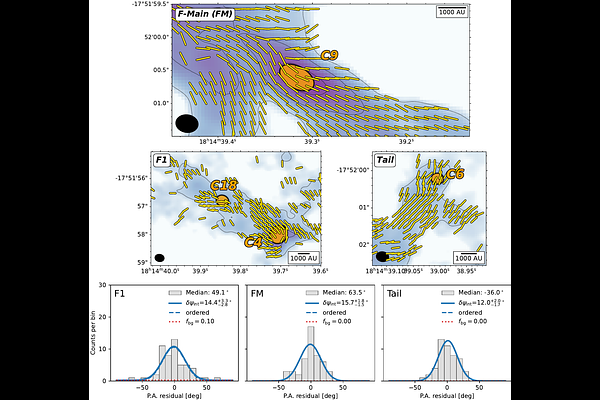
AbstractMagnetic fields (B-fields) are likely important in massive protocluster formation, but their role remains poorly constrained. We present 1.2 mm ALMA full-polarization observations of W33 A, a massive star-forming region at 2.4 kpc, with an angular resolution of 0.3 arcsec (730 au). The region is resolved into 20 dense cores and 9 filaments. The plane-of-sky B-field, inferred from linearly polarized dust emission, shows diverse structures: two nearly perpendicular large-scale components oriented northwest-southeast (NW-SE) and northeast-southwest (NE-SW), and two localized features toward the millimeter peaks MM1 and MM2. The NW-SE component could be shaped by a molecular outflow. The NE-SW component is coherent along the main filaments F1, F-Main, and Tail, all of which show trans-Alfvenic turbulence. In F-Main, the line mass exceeds the turbulent critical value, implying that magnetic support is required to prevent radial collapse and suppress fragmentation. In F1 and Tail, turbulence alone can support the gas against gravity, although B-fields may provide additional support. Toward MM1, the B-field follows a spiral-like infalling streamer traced by CH3CN. The trans-Alfvenic state of the accreting gas suggests efficient magnetic damping of turbulence and a magnetically regulated, laminar accretion flow feeding the core. Toward MM2, the B-field shows an hourglass morphology fitted by parabolic curves. Two independent methods give a consistent field strength of about 8.1(1.9) mG, and virial analysis indicates that the B-field is dynamically important in delaying collapse of MM2. Within a single protocluster, B-fields can stabilize filaments, regulate accretion, and delay core collapse, highlighting their diverse dynamic role in high-mass star formation.