Age-Related Changes in the Neural Dynamics of Speech Production Following Noninvasive Brain Stimulation

Age-Related Changes in the Neural Dynamics of Speech Production Following Noninvasive Brain Stimulation
Tabari, F.; Berger, J. I.; Johari, K.
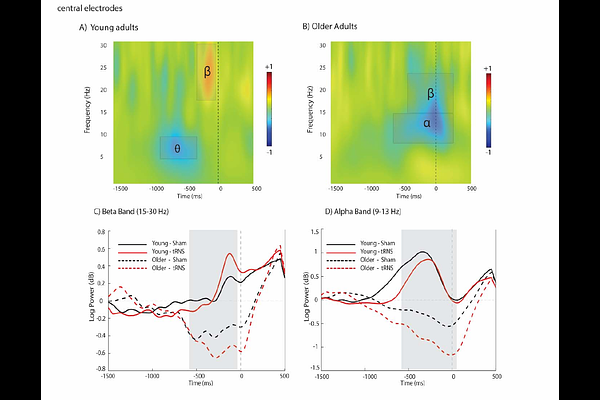
AbstractNon-nvasive brain stimulation is a promising technique to restore neural function in older adults by enhancing cortical excitability. In the present study, we examined the behavioral and neural effects of three stimulation protocols over the supplementary motor area on speech production in older adults. These protocols included fixed-frequency and personalized high-definition transcranial alternating current stimulation (HDtACS) and high-definition transcranial random noise stimulation (HDtRNS). We also compared the effects of personalized HDtACS and tRNS between younger and older adults. Two groups, older adults (mean age: 69 y) and younger adults (mean age: 19.87), participated in this study. Older adults attended a four-session experiment including sham, fixed-frequency beta-HD-tACS (17 Hz), personalized beta-HDtACS, and HDtRNS. Younger participants also followed a similar study design but without fixed-frequency beta-HD-tACS. Following 25 minutes of stimulation, participants were asked to complete a speech production task while their EEG activity was recorded. Both personalized tACS and tRNS significantly reduced reaction times compared to sham in younger and older adults. In older adults, personalized tACS and tRNS both effectively modulated speech motor network but exhibited distinct spatial profile. While personalized tACS produced more focal modulation, tRNS elicited broader modulation across distributed neural networks and engaged multiple oscillatory frequencies. Broadband and personalized stimulation approaches (personalized tACS and tRNS) were more effective than fixed-frequency beta-tACS in modulating behavioral and neural responses measured throughout a distributed speech-motor network in older adults.