Complement receptor-mediated uptake into renal mononuclear phagocytes promotes intracellular UPEC persistence and limits β-lactam efficacy in pyelonephritis

Complement receptor-mediated uptake into renal mononuclear phagocytes promotes intracellular UPEC persistence and limits β-lactam efficacy in pyelonephritis
Goldyn, B.; Babyak, O.; Rokkam, P.; Minchuk, Y.; Sutaj, M.; Lisowski, C.; Bluszcz, N.; Klaus, D.; Voelkel, A.; Amina, A.; Yin, J.; Kueh, A.; Hu, H.; Mueller, I.; Herold, M. J.; von Vietinghoff, S.; Engel, D. R.; Garbi, N.; Dobrindt, U.; Miethke, T.; Wagenlehner, F.; Jorch, S. K.; Kurts, C.
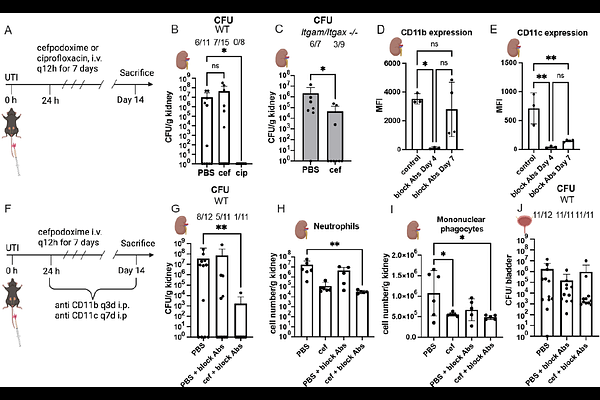
AbstractIntroduction: Acute pyelonephritis remains a major clinical problem. Relapses occur despite apparent-ly appropriate antibiotic therapy, suggesting that uropathogenic Escherichia coli (UPEC) persist in intrarenal niches. Intracellular bacterial reservoirs are a plausible explanation, but the relevant host cells, entry mechanisms and therapeutic implications in the kidney remain undefined. In principle, such reservoirs should favor choosing intracellularly active antibiotics, but increasing resistance to many of these agents leaves {beta}-lactams widely used in clinical practice, despite their predominantly extracellular activity. Methods: We analyzed murine pyelonephritis to identify the cellular reservoir of persistent UPEC. We generated mice genetically deficient for complement receptors CR3 and CR4 and tested their role in bacterial entry and persistence in vivo. Pharmacological complement receptor inhibition was applied to assess whether blocking bacterial re-entry into host cells improves antibiotic efficacy. Results: Renal MNP were identified as the major intracellular reservoir for UPEC in mice. Comple-ment opsonization enabled bacterial entry into these cells through CR3 and CR4, allowing UPEC to evade neutrophil-mediated killing and extracellularly active antibiotics. Genetic deletion of CR3 and CR4 abolished intracellular bacterial persistence and reduced renal bacterial burden. Because MNP undergo physiological turnover, intracellular UPEC must periodically exit host cells and infect new ones. Pharmacological inhibition of complement receptors prevented such bacterial re-entry and en-hanced the efficacy of {beta}-lactam antibiotics which cannot penetrate cell membranes. Conclusions: Complement receptor-mediated entry into renal MNP establishes an intracellular UPEC reservoir that promotes persistence during pyelonephritis. Blocking these receptors prevents renewal of the intracellular niche and improves {beta}-lactam efficacy in vivo.