Non-monotonic Age-metallicity Relations Across the Galactic Disk Revealed by APOGEE Red Clump Stars

Non-monotonic Age-metallicity Relations Across the Galactic Disk Revealed by APOGEE Red Clump Stars
Chun Wang, Yang Huang, Haibo Yuan
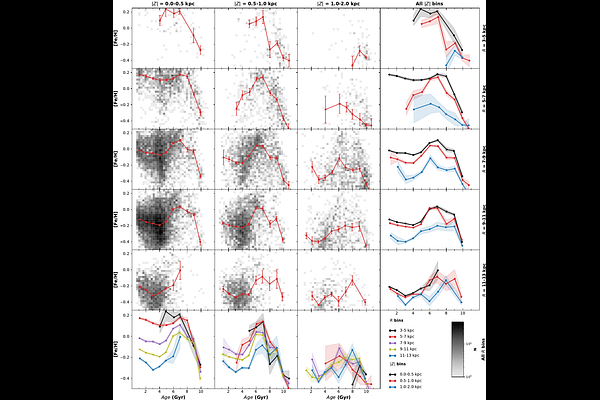
AbstractUsing APOGEE red clump stars and open clusters with precise ages, we investigate the age--metallicity relation (AMR) across the Galactic disk as a function of Galactocentric radius $R$ and vertical height $|Z|$. For stars older than $\sim$6--8 Gyr, the AMR shows little dependence on either $R$ or $|Z|$ within the uncertainties, suggesting rapid and well-mixed chemical evolution in the early disk. In contrast, younger populations exhibit a clear negative radial metallicity gradient, with the inner disk being more metal-rich than the outer disk, consistent with inside-out disk growth since $\sim$6--8 Gyr ago. Most importantly, at fixed location, the AMR for ages $\lesssim6$--8 Gyr is non-monotonic: [Fe/H] decreases toward younger ages, reaches a minimum at intermediate ages, and then rises again. Beyond $R\sim11$\,kpc, the relation becomes even more complex, exhibiting an additional reversal and a distinct metallicity peak at an age of $\sim2$\,Gyr. Such complex behavior cannot be explained by continuous local enrichment alone, but instead points to the combined effects of a multi-phase gas-accretion history and radial migration. Episodes of metal-poor gas inflow can dilute the interstellar medium and reset its chemical evolution, while subsequent enrichment raises the metallicity again; radial migration further reshapes the observed AMR by mixing stellar populations formed at different radii and metallicities. A toy model incorporating inside-out growth, two gas-inflow episodes, and radial migration qualitatively reproduces the observed trends, highlighting the combined roles of episodic gas accretion and radial migration in shaping the chemical evolution of the Galactic disk.