Machine learning-guided discovery of a conserved plasmid proteomic signature enables MALDI-TOF MS detection of pOXA-48-carrying Enterobacterales

Machine learning-guided discovery of a conserved plasmid proteomic signature enables MALDI-TOF MS detection of pOXA-48-carrying Enterobacterales
Sattler, J.; Mueller-Reif, J. B.; Chen, D.; Sommer, J.; Miranda, L.; Murris, J.; Schulz, T. H.; Guetlin, Y.; Rogenmoser, J.; Treit, P. V.; Pichl, T.; Sauerborn, E.; Seth-Smith, H. M. B.; Roloff, T.; Goettig, S.; Jantsch, J.; Wendel, A. F.; Moran-Gilad, J.; Mann, M.; Hamprecht, A.; Egli, A.; Borgwardt, K.
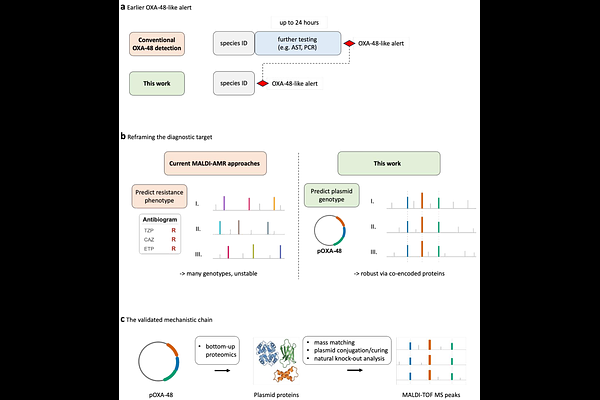
AbstractOXA-48 carbapenemases are among the most widespread and important resistance mechanisms in Enterobacterales. Yet detecting carbapenemases by conventional workflows necessitates additional testing, thus delaying optimization of therapy and implementation of infection control measures. Here, we present a machine learning approach that identifies the conserved pOXA-48 plasmid directly from routine MALDI-TOF spectra acquired for species identification. The model detects pOXA-48 carriers with an AUROC of 0.96-0.98 across two independent hospital cohorts and instrument platforms, indicating near-perfect discrimination. Using bottom-up proteomics, plasmid conjugation, and plasmid curing, we link the discriminative MALDI-TOF spectral features to proteins encoded on pOXA-48, with DUF1496 domain-containing protein producing the most discriminative spectral feature. Our approach reframes the resistance prediction task from inferring a resistance phenotype to detecting a conserved plasmid through its expressed proteomic signature and has the potential to enable rapid MALDI-TOF MS-based diagnostics for a wide range of plasmid-based resistance determinants.