Intrinsic T-cell programming and immune spatial organization govern sex-biased tuberculosis immunity

Intrinsic T-cell programming and immune spatial organization govern sex-biased tuberculosis immunity
Gupta, M.; Krug, S.; Neupane, S.; Shaku, M.; Chaulagain, S.; Lun, S.; Hoffmann, J. P.; Scully, E.; Klein, S. L.; Bishai, W.
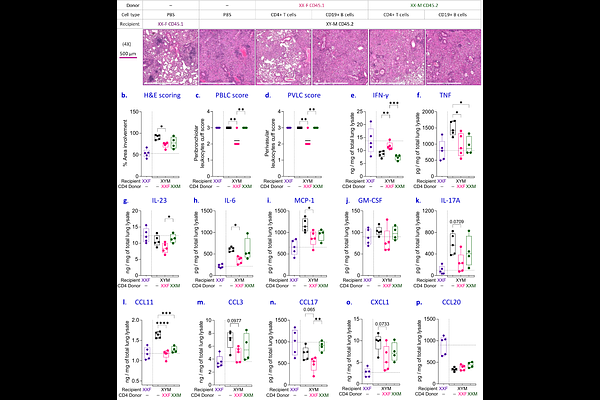
AbstractBiological sex can profoundly influence the susceptibility to infectious diseases, yet the mechanisms behind the sex-dependent protective immunity against tuberculosis (TB) remain poorly understood. Here we show that sexually divergent immunity during chronic Mycobacterium tuberculosis (Mtb) infection is governed by both intrinsic T cell programming and pulmonary immune spatial organization. Using the Four Core Genotype (FCG) mouse model, adoptive cell transfer, pathway-specific blockade and B cell depletion, we demonstrate that CD4 T cells from gonadal females (XXF), but not XX males (XXM), confer enhanced protection to susceptible XY male recipients, independently of sex chromosome complement. Female-derived CD4 T cells reduce Mtb burdens while promoting pulmonary Bcl6 CD4 T cell responses and limiting neutrophilic inflammation. Mechanistically, blockade of CXCR3 or CD40L abrogates female-associated protection, with CD40L signaling additionally required to maintain organized pulmonary B cell structures. Although depletion of conventional B-2 B cells did not impair bacterial control, it disrupted tertiary lymphoid organization and revealed striking sex-specific functions of pulmonary B cells. Loss of B cell follicles (BCFs) primarily remodeled adaptive T cell responses in females, whereas in males it drove inflammatory myeloid activation, exaggerated neutrophil recruitment and widespread neutrophil extracellular trap (NET) formation. Together, these findings identify two complementary layers of sex-dependent immune regulation during TB: intrinsic programming of protective female CD4 T cells, and B cell-dependent spatial organization that coordinates adaptive immunity in females while restraining pathological inflammation in males. These findings establish immune tissue organization as a key determinant of the sexually dimorphic host defense during chronic TB.