Contact calling is predicted by cooperative relationships in vampire bats

Contact calling is predicted by cooperative relationships in vampire bats
Vrtilek, J. K.; Gmutza, H.; Decker, S.; Carter, G. G.
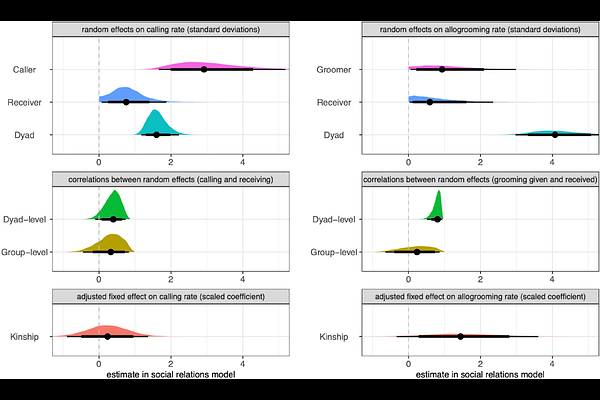
AbstractGroup-living animals often coordinate their behavior using "contact calls". Identifying the function of these calls requires testing whether they are intended for any group member or targeted to specific preferred associates. If contact calling is used to coordinate with preferred associates, then higher rates of contact calling are expected between group members with a history of more frequent affiliation and cooperation. To test this hypothesis, we constructed a contact-calling network using synchronized recordings of vocal interactions between all 28 possible pairs of 8 female common vampire bats with well-sampled histories of social grooming and regurgitated food sharing. Bayesian multilevel models show that pairwise rates of contact calling were clearly predicted by social grooming and cooperative allofeeding rates in ways not explained by kinship. These findings show that common vampire bats use contact calls to coordinate with specific same-sex associates, unlike other studied bat species where individuals produce contact calls at similar rates towards different group members. We also found that, compared to white-winged vampire bats, common vampire bats are ten times less likely to rapidly respond to a contact call; this suggests yet-to-be-discovered differences in social behavior between vampire bat species. Finally, we discuss implications for the "vocal grooming" hypothesis.