OmpA controls intracellular survival of Acinetobacter baumannii through TFEB activation and lysosomal remodeling

OmpA controls intracellular survival of Acinetobacter baumannii through TFEB activation and lysosomal remodeling
Molina Panadero, I.; Rey Hidalgo, A.; Lopez Carballo, M. J.; Atalaya Rey, C.; Munoz Ruiz, M. J.; Smani, Y.
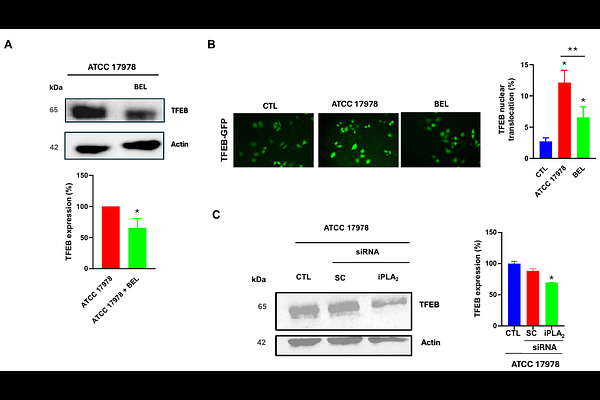
AbstractAcinetobacter baumannii is a high-priority multidrug-resistant pathogen that survives within host cells by hijacking intracellular defense pathways. Here, we identify a previously unrecognized signaling axis linking bacterial invasion to host lysosomal regulation. We show that A. baumannii activates calcium-independent phospholipase A2 (iPLA2), leading to increased lysophosphatidylcholine (LPC) production and calcium influx through the ORAI1 channel, which together drive activation and nuclear translocation of the lysosomal transcription factor EB (TFEB). Pharmacological inhibition or genetic silencing of iPLA2 or ORAI1 markedly impaired TFEB activation and lysosomal biogenesis. Mechanistically, we demonstrate that this pathway is initiated by the outer membrane protein A (OmpA), which promotes bacterial invasion and enhances iPLA2 activity, LPC production, and downstream TFEB signaling. Despite induction of lysosomal biogenesis, A. baumannii persists intracellularly by producing ammonia and alkalinizing the lysosomal environment, thereby counteracting host antibacterial activity. In vivo, infection induces activation of HLH-30, the TFEB ortholog, in Caenorhabditis elegans in an OmpA-dependent manner. Together, our finding define an OmpA-iPLA2-LPC-ORAI1-TFEB signaling axis that coordinates host lipid and calcium signaling with lysosomal responses, while revealing a bacterial counterstrategy that promotes intracellular survival.