A Nonlinear Biomechanical Model for Prognostic Analysis of Clavicle Fractures

A Nonlinear Biomechanical Model for Prognostic Analysis of Clavicle Fractures
Chen, Y.
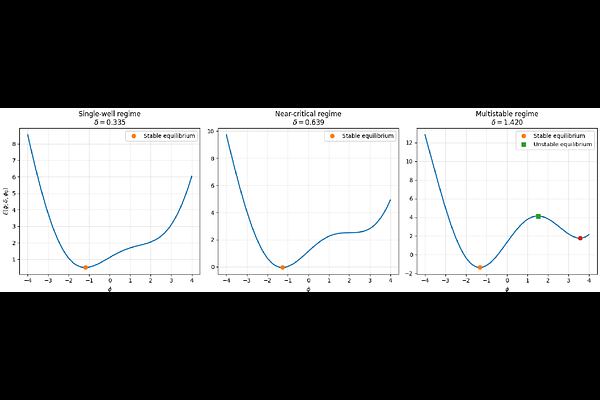
AbstractClavicle fractures often exhibit markedly different clinical outcomes: some patients recover acceptable function despite shortening or displacement, whereas others with apparently similar deformity develop persistent pain, functional loss, or poor healing. To explain this distinction, we propose a minimal nonlinear mechanical model for prognostic analysis of clavicle fractures. The model describes the interaction between fracture-related shortening and compensatory shoulder-girdle posture through a reduced equilibrium equation incorporating stiffness, geometric nonlinearity, and shortening-posture coupling. Within this framework, we analyze equilibrium branches, local stability, and the emergence of critical thresholds. We show that post-fracture destabilization can be interpreted as a fold bifurcation, while more complex parameter dependence gives rise to cusp-type structures and multistability. These bifurcation mechanisms provide a mathematical explanation for sudden deterioration after injury or treatment, as well as for strong inter-individual variability. We further introduce an optimization principle based on a utility functional to guide treatment planning. The analysis predicts that the optimal safe correction should lie strictly below the bifurcation threshold, thereby generating a natural safety margin. Although the model is simplified and has not yet been calibrated against patient data, it nevertheless provides a theoretical framework for understanding why fracture prognosis may deteriorate abruptly near critical mechanical conditions and offers a dynamical-systems interpretation of empirical treatment thresholds used in clinical practice.