Early development of Neanderthals revealed through virtual microanatomy

Early development of Neanderthals revealed through virtual microanatomy
Miszkiewicz, J. J.; Godinho, R. M.; Sohler-Snoddy, A. M.; Pasda, K.; Detroit, F.; Mahoney, P.; Rathgeber, T.; Posth, C.; Uthmeier, T.; Barbieri, A.
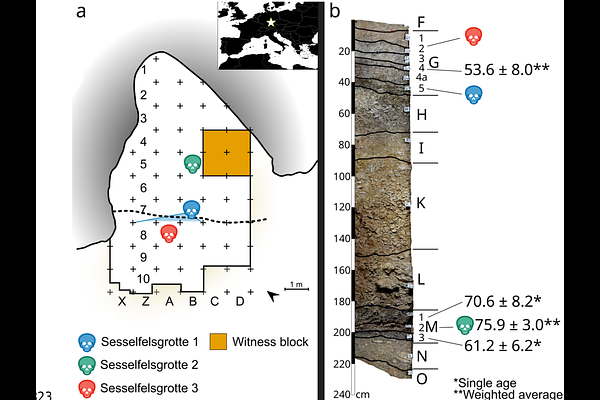
AbstractThe ontogeny of Neanderthal (Homo neanderthalensis) perinates is poorly understood due to the paucity of juvenile skeletal remains. Here we reconstruct fetal bone growth, and explore deciduous tooth structures, in three Neanderthal juveniles (Sesselfelsgrotte, 1, 2 and 3) (90,000-50,000 years ago) from southeastern Germany using non-destructive microcomputed tomography. Sesselfelsgrotte 1 exhibited bone tissue consistent with modern human perinatal plexiform-like structures and primary osteons. Long bones showed regions of advanced growth compared to the mandible and frontal bone, which can be explained through different processes of ossification and potentially localized faster development in Neanderthals compared to modern humans. Bone microstructure resembles that of the late third trimester of modern humans, agreeing with previous estimates based on macroscopic data. Sesselfelsgrotte 2 and 3 deciduous teeth retain hypodensities deep within the crown dentine consistent with interglobular dentine. We conclude that the fetal bone patterning is similar to modern humans with areas of advanced growth, indicating that the growth trajectory for this Neanderthal perinate was broadly equivalent to that of modern humans. The abnormal dentine mineralization points toward a possible systemic disorder.