Cosmic evolution of the [CII]-to-molecular gas relation

Cosmic evolution of the [CII]-to-molecular gas relation
Cédric Accard, Florent Renaud, Katarina Kraljic, Diana Ismail, Matthieu Béthermin, Oscar Agertz
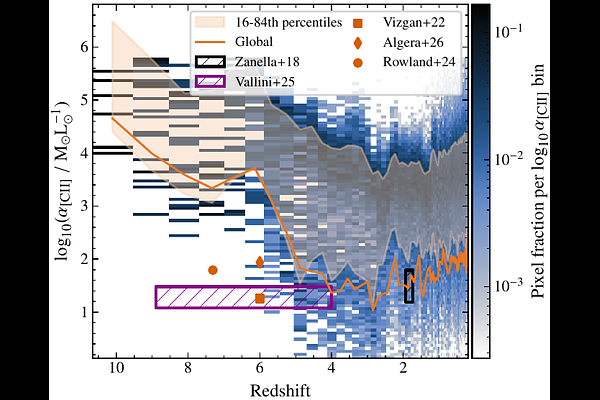
AbstractThe [CII] 158 $μ$m line is widely used to trace star formation and the gas contents of high-redshift galaxies. However, it remains unclear under which physical conditions it reliably traces the molecular reservoir, and whether a unique conversion factor $α_{\rm [CII]}$ can be applied across cosmic time. We investigate the evolution of the relation between the [CII] luminosity and molecular gas mass from $z\simeq10$ to $z\simeq0.2$ using the Vintergatan simulation, a high-resolution cosmological zoom-in of a Milky Way-like galaxy. We post-process the snapshots with the Skirt radiative transfer code to generate synthetic [CII] data cubes. We measure global and spatially resolved (100 pc) relations between [CII] luminosity ($L_{\rm [CII]}$), star formation rate (SFR), and molecular gas mass ($M_{\rm mol}$). We follow the redshift evolution of the [CII]-to-molecular gas conversion factor $α_{\rm [CII]}$, and link these trends to the evolution of the interstellar medium (ISM) phases. The global $L_{\rm [CII]}$-$M_{\rm mol}$ and $L_{\rm [CII]}$-SFR relations evolve from a steep, [CII]-deficient regime at very low metallicity to an almost linear behaviour, similar to calibrations at $z\approx2$, once the ISM reaches $Z \gtrsim 0.05$-$0.1\,Z_\odot$ at $z\lesssim5$. Over this evolution, $α_{\rm [CII]}$ spans nearly three orders of magnitude, from $\gtrsim 10^4$ down to $\approx10 \,\rm{M_\odot\,L_\odot^{-1}}$, even though the [CII] emission remains spatially correlated with the molecular gas. A unique, redshift-independent $α_{\rm [CII]}$ therefore cannot recover molecular gas masses across the regimes we explore. [CII] remains a viable tracer of molecular gas at very high redshifts, but only when used with conversion factors that explicitly account for metallicity, ISM phase mix, and merger events.