Interaction between vegetation and Snowball phases in the late Proterozoic Earth

Interaction between vegetation and Snowball phases in the late Proterozoic Earth
Erica Bisesi, Giuseppe Murante, Antonello Provenzale, Jost von Hardenberg, Michele Maris, Laura Silva
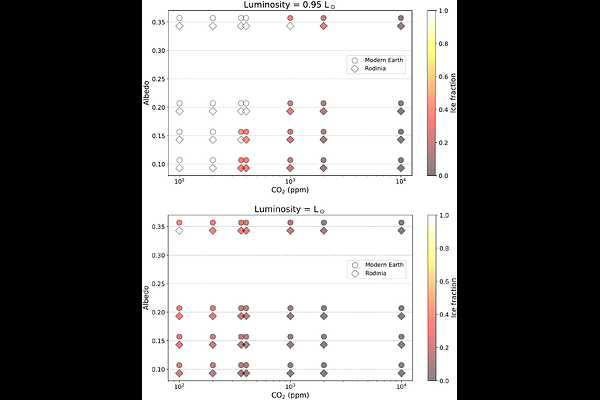
AbstractBetween 2.4 and 0.6 Gy ago, our planet underwent several episodes of global glaciations, including the Snowball Earth case that ended 635 My ago. Causes of this last Snowball event presumably included a decreased greenhouse gas concentration and high continental albedo, both associated with the passage of the super-continent Rodinia at equatorial latitudes. When large continental masses are in equatorial regions, silicate weathering is enhanced, leading to decreased atmospheric CO2 concentration, while the bare continental masses, which at the time hosted no vegetation, enhanced reflection of solar radiation. Since then, no other Snowball episodes were recorded. Here we numerically explore the climatic dynamics of a rocky planet for different values of solar output, continental configuration (current and Rodinia-like), CO2 concentration and continental albedo, simulating the effects of land vegetation. We found that for the solar input typical of 600-700 My ago (95% of the current value), the presence of bare continents with albedo 0.35 (granite) in the position estimated for Rodinia was sufficient to trigger a Snowball state for CO2 concentrations up to at least 1000 ppm. When bare continents are located in modern positions, Snowball could be triggered only for values of CO2 concentration below 400 ppm. At current solar input values, Snowball states appear only at or below 100 ppm. Thus, we found: a lower solar output is an essential component of the transition to Snowball; the presence of land vegetation is crucial and reduces the probability of entering a Snowball state; a low CO2 concentration was not needed for triggering a Snowball in bare Rodinia-like conditions and reduced solar output; current solar luminosity does not allow Snowball states, even for equatorial continents, unless continental albedo is that of granite and CO2 concentration is 100 ppm or less. [Abridged]