JWST/NIRSpec observations of AMORE6 suggest active Pop~III star formation in a self-polluted galaxy

JWST/NIRSpec observations of AMORE6 suggest active Pop~III star formation in a self-polluted galaxy
Mirko Curti, Elka Rusta, Stefania Salvadori, Stefano Carniani, Francesco D'Eugenio, Bianca Moreschini, Roberto Maiolino, Alessandro Marconi, Giacomo Venturi, Francesco Belfiore, Elisa Cataldi, Viola Gelli, Yuki Isobe, Xihan Ji, Mingyu Li, Robert G. Pascalau, James A. A. Trussler, Hannah Übler
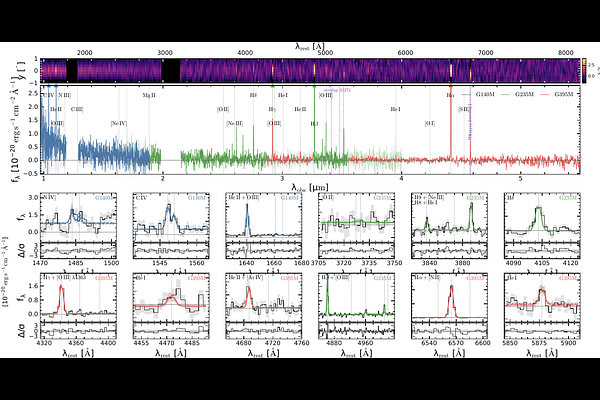
AbstractAMORE6 is a strongly lensed ($μ\simeq78$), intrinsically faint galaxy at $z=5.725$, previously proposed as a metal-free candidate from the absence of [OIII]$λ$5007 in NIRCam slitless spectroscopy. We present deep JWST/NIRSpec spectroscopy of its brighter image, AMORE6-B. We detect HeII$λλ$1640,4686, with HeII$λ$4686/H$β=0.080\pm0.015$ and EW(HeII$λ$4686)$=35\pm8$ Å, weak [OIII] ($R_3=0.25$) and CIV$λλ$1548,51, and no other metal lines. H and He lines give negligible attenuation, $T_e\simeq2\times10^4$ K, and $Y=0.226^{+0.022}_{-0.024}$. The oxygen abundance, $12+\log(O/H)\simeq6.08^{+0.24}_{-0.80}$ (0.04-0.4% $Z_\odot$, depending on the calibration), is the lowest at its stellar mass, while C/O is near or above solar. Photoionization models of different ionizing sources favour metal-free stars with a top-heavy initial mass function (IMF), as in the self-polluted phase of simulated Population III (Pop III) galaxies, or a metal-poor population with a luminous hard X-ray source; ordinary metal-poor populations, very massive stars, and accretion-based sources are disfavoured. A full SED fit in the fiducial self-polluted scenario gives $1.3\times10^5\,M_\odot$ of Pop III stars formed within the last 4 Myr, which ionize mildly enriched gas and leak 86% of their ionizing photons. The HeII-to-Balmer ratio constrains the slope $x$ and characteristic mass $M_{ch}$ of the Pop III IMF jointly, to $90x-268\lesssim M_{ch}/M_\odot\lesssim172x-330$ ($3σ$; $M_{ch}\lesssim70\,M_\odot$ for a Salpeter slope), excluding the most top-heavy IMFs allowed by near-field constraints. X-ray binaries are a possible alternative, but require either a metal-poor population too young (1 Myr) to host compact objects and an X-ray luminosity far above that of metal-poor galaxies, or $2\times10^6\,M_\odot$ of older Pop III.2 stars whose metals were mostly expelled.