Spatiotemporal bioprinting of microtissues and growth factors within a support bath to engineer anisotropic, zonally defined meniscal grafts

Spatiotemporal bioprinting of microtissues and growth factors within a support bath to engineer anisotropic, zonally defined meniscal grafts
Spagnuolo, F. D.; Soares Kronemberger, G.; Kelly, D.
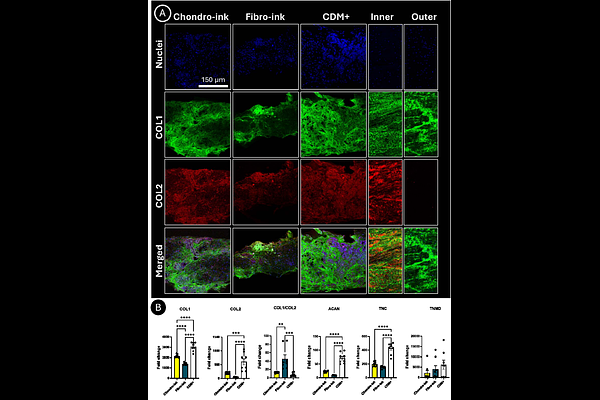
AbstractCurrent clinical treatments for meniscal injuries remain limited and are associated with an increased risk of developing osteoarthritis (OA). This has motivated the development of tissue engineering (TE) strategies to engineer more biomimetic meniscal grafts capable of promoting functional joint regeneration. Existing approaches typically fail to recapitulate the zonal heterogeneity of the native meniscus, which contains distinct inner and outer regions with unique extracellular matrix (ECM) composition and organization. Here, we introduce a novel bioprinting strategy using spatially patterned growth factors and mesenchymal stromal/stem cell (MSC)-derived microtissues (Ts) to engineer meniscal constructs with zonally defined structure and composition. We first investigated the effects of different growth factor regimes, specifically connective tissue growth factor (CTGF) and transforming growth factor-{beta}3 (TGF-{beta}3), on fibrochondrogenesis of MSC-derived Ts. While TGF-{beta}3 alone promoted a more inner-zone meniscus phenotype, stimulation of Ts with a combination of TGF-{beta}3 and CTGF supported the development of tissues that more closely mimicked the outer zone of the meniscus. Using laponite to control the release of these growth factors, it was also possible to bioprint zonally defined meniscal tissue within a methacrylate xanthan gum (XG-MA) support bath. A 'fibro-ink' containing Ts, CTGF and TGF- {beta}3 supported higher collagen type I deposition and lower collagen type II deposition, while a 'chondro-ink' containing Ts and TGF-{beta}3 promoted higher collagen type II deposition. Based on these findings, dual-cartridge bioprinting was next used to spatially pattern Ts with CTGF + TGF-{beta}3 (fibro-ink) or TGF-{beta}3 (chondro-ink) to generate regionally defined, meniscal-like engineered tissues. This approach enabled the bioprinting of scaffold-free constructs with aligned collagen and zone-specific ECM depositions, with an inner region consisting of sGAG and collagen types I and II, and an outer region rich in sGAG and collagen type I. These findings highlight the potential of co-printing both growth factors and MSC-derived Ts for engineering scaffold-free, zonally defined meniscal tissues.