Evaluating Preservation Techniques for Long-Term Stability of 3D Bioprinted Liver Scaffolds

Evaluating Preservation Techniques for Long-Term Stability of 3D Bioprinted Liver Scaffolds
S.V., K.; Gadre, M. A.
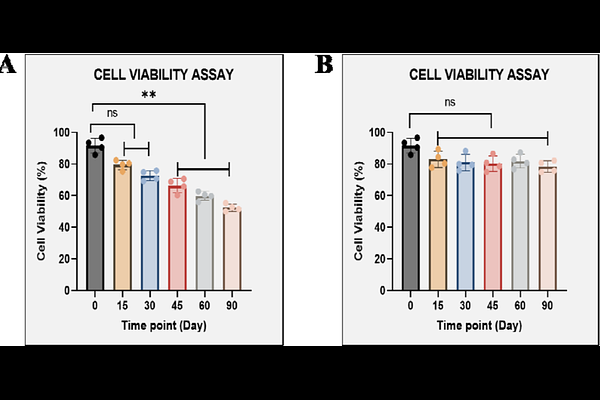
AbstractThree-dimensional (3D) bioprinted liver scaffolds offer a promising platform for drug screening, disease modelling, and regenerative medicine, yet their broader adoption is limited by the absence of robust post-fabrication preservation strategies. This study aimed to evaluate the impact of -80 degree Celsius (deep freezer) preservation and evaluate the structural integrity and hepatic functionality of GelMA decellularized liver extra cellular matrix (dECM) based 3D bioprinted liver scaffolds. Bioinks were formulated using synthesized GelMA and solubilized rat liver dECM, and 3D scaffolds were fabricated via extrusion bioprinting into rectilinear grid scaffolds. The 3D scaffold preservations was performed by immersion into two different medium (the culture DMEM media and the other FBS-DMSO cocktail) was evaluated using MTT viability assay, and albumin assay. Preserved 3D bioprinted scaffolds retained overall architecture and cell distribution in the FBS-DMSO cocktail demonstrated by the live dead assay. Together, the data demonstrate that -80 degree Celsius storage can maintain the basic cell viability (~80%) and a substantial fraction of liver-specific functionality in 3D bioprinted scaffolds but also highlight sensitivity to preservation-induced injury. These findings underscore the need for further optimization of cryoprotectant formulations and freezing protocols tailored to 3D bioprinted liver scaffolds and provide a foundational framework for developing ready to use, cryopreserved 3D liver models for translational applications.