Survivorship Bias Explains Age-Dependent Extinction in Fossil Genera

Survivorship Bias Explains Age-Dependent Extinction in Fossil Genera
Tikhonov, M.; Sneppen, K.; Bornholdt, S.; Maslov, S.
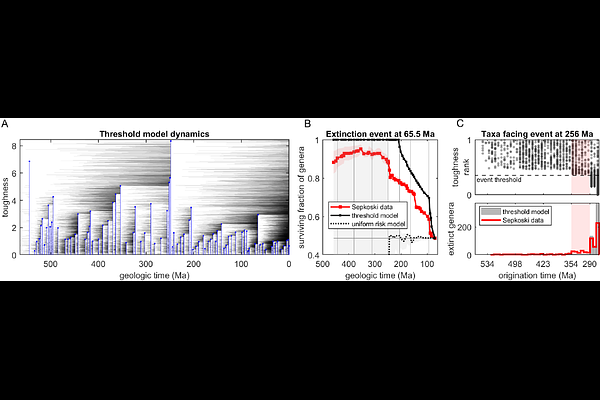
AbstractFossil genera exhibit pronounced age-dependent extinction: older genera are more likely to survive extinction events than younger ones. Many biological mechanisms have been proposed that could make lineages progressively more resistant to extinction through time. However, the same pattern can also arise from survivorship bias: as more vulnerable genera are progressively eliminated, the surviving pool becomes increasingly enriched in robust lineages, even if the properties of individual lineages never change. Using the Sepkoski marine genus compendium, we construct a quantitative model based solely on survivorship bias and ask whether additional age-dependent changes are required to explain the fossil record. This model with a single fitting parameter quantitatively reproduces the full set of age-conditioned survival probabilities, together with the overall dependence of extinction risk on genus age and the genus lifetime distribution. Allowing extinction resistance to change systematically through time yields no measurable improvement, indicating that, at least at the aggregate statistical level, explicit age-dependent changes in lineage properties are not required to explain the observed patterns of extinction. These results show that our minimal one-parameter model provides a quantitative null model for age-dependent extinction, against which proposed biological mechanisms can now be tested.