Computation of complex dust grain optical properties: Optimisation method by equivalent representation (OMER)

Computation of complex dust grain optical properties: Optimisation method by equivalent representation (OMER)
M. -A. Carpine, N. Ysard, A. Maury
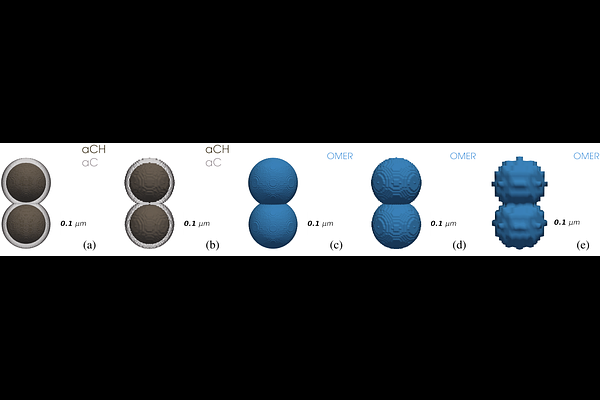
AbstractComputing the optical properties of dust grains is important for understanding various astrophysical environments. However, the numerical methods used to compute these properties require significant computing resources for irregularly shaped or inhomogeneous particles that are representative of realistic grown dust. This study aims to provide an efficient yet accurate Discrete dipole approximation (DDA) computation method for large aggregates with 'complex' monomers and structural details or compositional inhomogeneities. We propose the optimisation method by equivalent representation (OMER) method, which uses optimisation of the optical properties of a known monomer to find an equivalent homogeneous sphere. This sphere can then be used as a substitute for the complex monomer in large aggregates. The method provides a good approximation of complex monomers, as demonstrated in test cases involving large aggregates. Compared to existing methods, OMER shows greater accuracy, particularly in the range from visible to submillimetre wavelengths. The gain in computing time depends on the grain but can exceed two orders of magnitude. The proposed method provides a fast and accurate approximation for estimating the optical properties of materials with complex shapes and paves the way for efficient computation cross-sections for complex dust grain aggregates with thin core-mantle structures or hierarchical aggregates of large sizes.