Resolving the Dust Budget Crisis at $z \sim 8$ with Optically Thick, High-Density Molecular Clumps: MACS0416_Y1

Resolving the Dust Budget Crisis at $z \sim 8$ with Optically Thick, High-Density Molecular Clumps: MACS0416_Y1
Ryusei R. Kano, Tsutomu T. Takeuchi, Erina R. Kawamoto, Ryosuke S. Asano, Masato Hagimoto, Yoichi Tamura
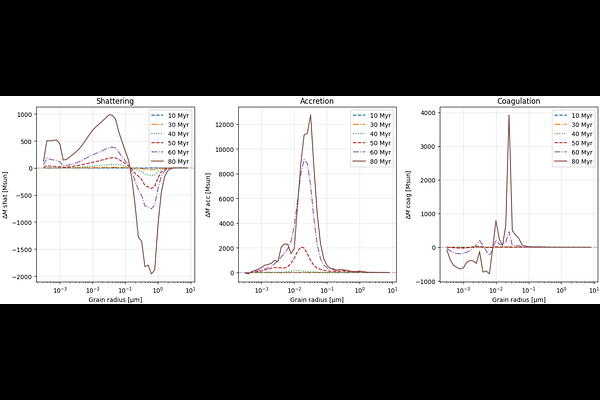
AbstractDust plays a crucial role in galaxy evolution by shaping the spectral energy distribution (SED) and star formation history. However, standard models often underestimate the infrared luminosity of high-redshift galaxies ($z \sim 8$), leading to the so-called dust budget crisis. In this work, we modify the theoretical framework by focusing on compact star-forming clumps in the interstellar medium. Motivated by the observed compactness of high-z galaxies, we treat the cold neutral medium density as a free parameter. Our analysis reveals that the ISM must reach extreme densities ($n_{\text{H,CNM}} \sim 7.5 \times 10^3 \, \mathrm{cm}^{-3}$). This enhances UV photon trapping, accelerates dust processing in dense gas, and reduces dust destruction by supernova shocks. Our model successfully reproduces the observed UV-to-FIR SED of MACS0416_Y1 ($z = 8.312$). A grain-size-resolved treatment further shows that the warm IR emission is dominated by intermediate-size grains ($a = 0.01$ - $0.1\,μ$m), which contribute about 89% of the luminosity near the SED peak and in the ALMA Band~9 continuum. These grains are nearly in thermal equilibrium at characteristic temperatures of $\sim 70$ K, while the largest grains remain cooler and the smallest grains exhibit a high-temperature tail with low probability. We conclude that extreme ISM densities can alleviate the dust budget crisis by promoting efficient UV photon trapping and rapid dust evolution, thereby increasing dust mass and producing a multi-temperature grain population.