Beyond biodiversity loss defaunation: cascades effects in zoonotic disease ecology

Beyond biodiversity loss defaunation: cascades effects in zoonotic disease ecology
Aramburo Jaramillo, F.; Cordovez, J. M.; Bello, C.; Santos-Vega, M.
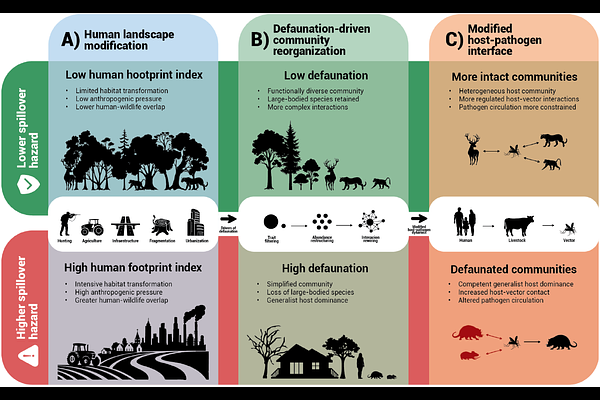
AbstractDefaunation, defined as the loss or severe decline of animal populations, is increasingly recognized as a major dimension of global environmental change, yet its role in zoonotic disease ecology remains poorly understood. Although defaunation significantly influences ecological dynamics, current metrics often focus on species loss without fully addressing its cascading impacts, which can affect ecological processes such as zoonotic disease transmission. In this perspective, we propose a defaunation-cascade framework linking anthropogenic pressure to zoonotic pathogen dynamics through four ecological steps: host trait filtering, abundance restructuring, interaction rewiring, and altered pathogen circulation or proliferation, and potential spillover hazard. We illustrate this framework by using a global review of empirical studies and combining georeferenced data on disease prevalence with environmental and human-related factors. Our exploratory models suggest pathogen-specific associations: parasitic and bacterial prevalence were more strongly associated with anthropogenic pressure and mammal diversity metrics, whereas viral prevalence showed weaker support. We contend that incorporating defaunation cascades into One Health surveillance will improve ecological understanding of pathogen circulation and enhance the ecological accuracy and predictive power of zoonotic disease models, thereby identifying landscapes where faunal simplification may elevate spillover hazard.