Implicit representation of viruses fails to capture impacts of virus-induced mortality in global marine ecosystem models

Implicit representation of viruses fails to capture impacts of virus-induced mortality in global marine ecosystem models
Talmy, D.; Carr, E. A.; Fremont, P.; Demory, D.; Follett, C. L.; Jahn, O.; Muratore, D.; Beckett, S. J.; Lindell, D.; Weitz, J. S.; Dutkiewicz, S.
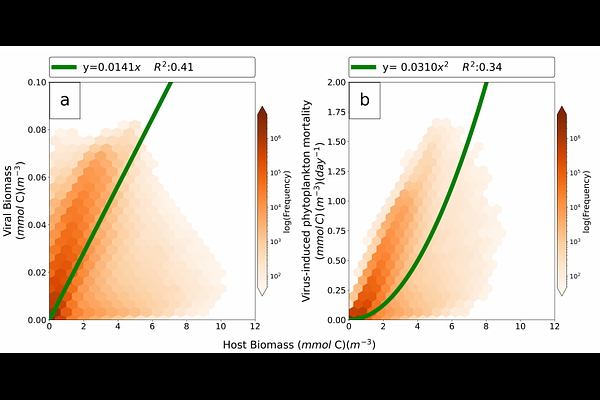
AbstractVirus-induced mortality influences plankton biogeography, community structure, and ocean elemental cycles. However, quantification of virus-induced impacts remains challenging and often limited in scope. An alternative to explicit inclusion of viral dynamics in biogeochemical models is to represent viral effects implicitly, by assuming that mortality increases quadratically with cell or biomass density. Using 1D and 3D configurations of a nutrient-phytoplankton-zooplankton-virus-detritus (NPZVD) model, we ask whether the implicit quadratic mortality assumption captures patterns of virus-induced mortality, and its impact on biomass and primary production. The 1D water-column configuration shows that, at the onset of the spring bloom, the quadratic, implicit representation imposes viral losses on phytoplankton density instantaneously, which limits spring bloom formation. This is in contrast to the explicit representation, which allows initial bloom formation to proceed unhampered initially, but imposes a far stronger viral mortality later in the year driven by high rates of host-virus contact due to high phytoplankton and viral densities that take time to accumulate. By comparison to the implicit model, explicit resolution of viruses within the 3D global model shows strong potential for viruses to prematurely terminate phytoplankton blooms. Biogeochemical models would therefore benefit from explicit representation of viral infection insofar as models can be developed that adequately recapitulate in situ observations.