Stellar flare-driven evolution of primordial early exo-Earth atmospheres: Insights from a Young M Dwarf Flare model

Stellar flare-driven evolution of primordial early exo-Earth atmospheres: Insights from a Young M Dwarf Flare model
E. Mamonova, K. Herbst, V. Kofman, O. Ozgurel, A. F. Kowalski, S. Wedemeyer, S. C. Werner
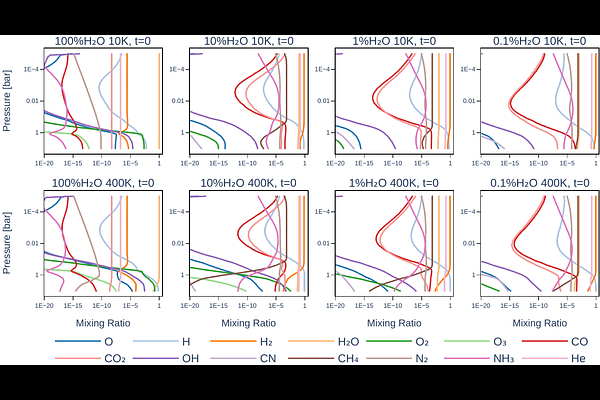
AbstractContext. M dwarfs are key targets for terrestrial exoplanet studies, with prospects for atmospheric spectroscopy. However, strong stellar magnetic activity and frequent flaring require modelling efforts to assess their impact on planetary atmospheres. Aims. We aim to investigate one year of atmospheric chemical evolution of a young exo Earth orbiting an active M dwarf by coupling our Young M Dwarfs Flare (YMDF) model of stellar activity with the VULCAN chemistry kinetic code. Methods. The YMDF model provides time-resolved spectral energy distributions for high- and low-energy electron beam-driven flares, which are used as external radiative inputs to VULCAN to compute the time-dependent photochemistry and kinetics for different primordial atmospheric scenarios. Results. We present the impact of stellar flares on atmospheres with varying water vapour content, ranging from a plausible primordial atmosphere with solar abundances, representative of a planet-forming region in a dissipating protoplanetary disk, to an extreme water-steam atmosphere with minimal other species. This was explored across several configurations: variable flux in the YMDF model, the previous model representing an active but older M dwarf with added 10K or 400K bottom boundary heat flux, and a constant stellar flux model. Conclusions. Our study suggests that, compared to the previous model, the YMDF model produces synthetic flares that exert significantly greater stress on primordial atmospheres, regardless of the water-vapour content. Increased activity and prevalence of mid-size flares have the potential to induce permanent changes in atmospheric mixing ratios, especially in species with low abundances.