Japanese quail (Coturnix japonica) selected for high social motivation rely on conspecifics for buffering but not learning in sociocognitive tasks

Japanese quail (Coturnix japonica) selected for high social motivation rely on conspecifics for buffering but not learning in sociocognitive tasks
SERESSIA, J.; Morel, A.; Cornilleau, F.; Lemarchand, J.; Lansade, L.; Nawroth, C.; Calandreau, L.; Ferreira, V. H. B.
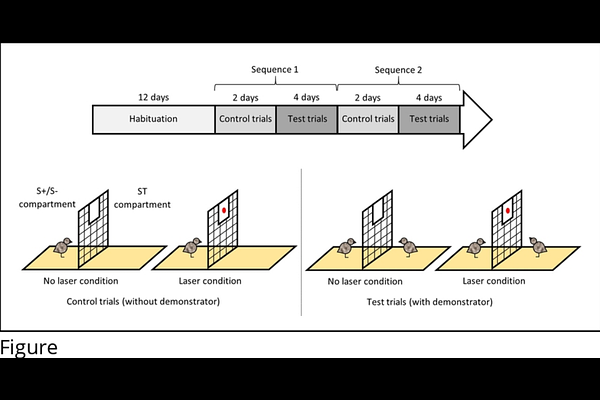
AbstractSocial living is widely considered a key driver of cognitive evolution, yet individuals within a species and even within the same group can differ substantially in their sociability (i.e., an individuals propensity to form and maintain social bonds), which can ultimately shape the social environment they experience by influencing how they interact with, respond to, and engage in it. How such individual variation in this personality trait affects social cognition, however, remains poorly understood. To address this question, we used two selectively bred lines of Japanese quail (Coturnix japonica) that consistently differ in social motivation, a key component of sociability, which we used as a proxy for this broader trait. In these lines, S+ individuals show high social motivation, whereas S- individuals show low social motivation. We compared their sociocognitive performance across three tasks: a gaze following task, a social buffering task, and a social discrimination learning task. Our findings revealed that Japanese quail reliably followed the gaze of conspecifics, providing the first evidence of this ability in this species. However, there was no difference between lines, suggesting that basic gaze following into the distance is independent of social motivation. In contrast, line differences emerged in the other tasks. S+ quail were more sensitive and less adaptable in response to environmental changes, particularly under social isolation, although the presence of a conspecific strongly buffered these effects. S- quail, on the other hand, outperformed S+ individuals in the social discrimination learning task, rapidly exploiting available social cues to guide foraging decisions. Overall, this study demonstrates that social motivation modulates sociocognitive performance in a context-dependent manner. Rather than conferring a general cognitive advantage, divergent selection on social motivation leads to different strategies of social information use across tasks and contexts, highlighting the complex interplay between personality, social environment, and cognition.