RABBITS - III. Modelling relativistic accretion discs around spinning black holes in galaxy formation simulations

RABBITS - III. Modelling relativistic accretion discs around spinning black holes in galaxy formation simulations
Dimitrios Irodotou, Shihong Liao, Theodoros Nakas, Geoffrey Compère, Roberto Oliveri, Jessica M. Hislop, Alexander Rawlings, Sonja Soininen, Aswin P. Vijayan
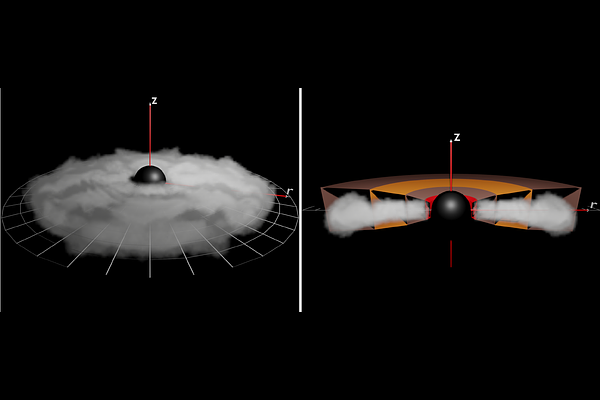
AbstractIn this third study of the 'Resolving supermAssive Black hole Binaries In galacTic hydrodynamical Simulations' (RABBITS) series we develop and implement a geometrically thin relativistic accretion disc model, which self-consistently evolves the mass and spin vector of black holes via analytically modelling the structure of steady-state accretion discs. The model employs a suite of relativistic, local solutions where pressure is dominated by either gas or radiation, while opacity is primarily governed by either electron scattering or free-free absorption. These local solutions are piece-wisely combined to form the global structure of the accretion disc based on each solution's range of validity. By explicitly modelling the structure of accretion discs, the model mitigates the stochasticity inherent in Bondi-type prescriptions, resulting in an approach where every episode of black hole mass accretion is derived from first principles. For the first time, our model enables galaxy formation simulations to place constraints on accretion disc sizes and structures. In addition, flux and temperature radial profiles can be directly extracted from the simulation, enabling the generation of spectral energy distributions. Consequently, by incorporating the thermal structure and spacetime geometry around spinning black holes, our model more accurately captures the energetic output of quasars, overcoming critical limitations of classical approaches. Along with this manuscript, we make public a C version of the model appropriate to be used as a module in simulations, a Python version of the model that can be used independently to post-process any simulation and build mock accretion discs, and an updated version of the Relagn model that has the capability of producing SEDs by building an accretion disc for a given set of parameters and extracting its surface density, temperature, and opacity profiles.