A novel mechanism of ceftolozane-tazobactam resistance in Pseudomonas aeruginosa mediated by L2 β-lactamase

A novel mechanism of ceftolozane-tazobactam resistance in Pseudomonas aeruginosa mediated by L2 β-lactamase
Garai, P.; Nozick, S.; Jozefczyk, C. C.; Nam, H.; O?Donnell, J. N.; Ozer, E. A.; Hauser, A. R.; Rhodes, N. J.
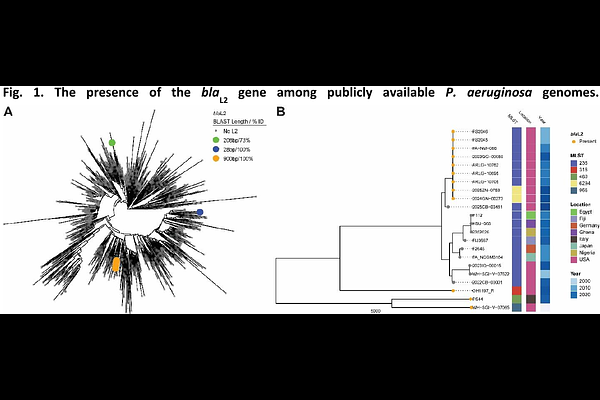
AbstractThe prevalance of non-susceptibility to ceftolozane-tazobactam (C/T) among Pseudomonas aeruginosa remains low but novel mechanisms of C/T resistance are of concern. Herein, we describe a novel Pseudomonas aeruginosa genotype associated with high-level C/T resistance (>256/4 g/mL) in a single patient. Whole genome sequencing of the isolate was compared to that of a susceptible isolate cultured from the same patient two months earlier. Analysis of the sequences revealed two different P. aeruginosa high-risk clones: ST111 followed by ST235. The C/T-resistant ST235 isolate contained five copies of a genetic element comprised of an L2 {beta}-lactamase gene (blaL2) and a truncated ampR L2 transcriptional regulator gene, which are commonly found together in S. tenotrophomonas maltophilia strains and have not been reported to mediate resistance to C/T. Comparative genomic analysis with other P. aeruginosa isolates failed to identify alternative explanations for the observed C/T resistance. We found that exogenous expression of blaL2 modestly increased C/T MICs in genetically distinct P. aeruginosa strains. A screen of our archived isolates identified two P. aeruginosa clinical isolates, PS2045 and PS2046, with one and two copies, respectively, of the genetic element containing blaL2 and truncated ampR L2. Interestingly, disruption of the gene blaL2 but not the truncated ampR L2 in PS2045 led to a significant decrease in C/T MIC. Thus, we report a novel mechanism of C/T resistance in P. aeruginosa mediated by an L2 {beta}-lactamase independently of its canonical regulator AmpR L2.