Nearest Neighbour-Based Statistics for 21cm-Galaxy Cross-Correlations in the Epoch of Reionization

Nearest Neighbour-Based Statistics for 21cm-Galaxy Cross-Correlations in the Epoch of Reionization
Anirban Chakraborty, Kwanit Gangopadhyay, Arka Banerjee, Tirthankar Roy Choudhury
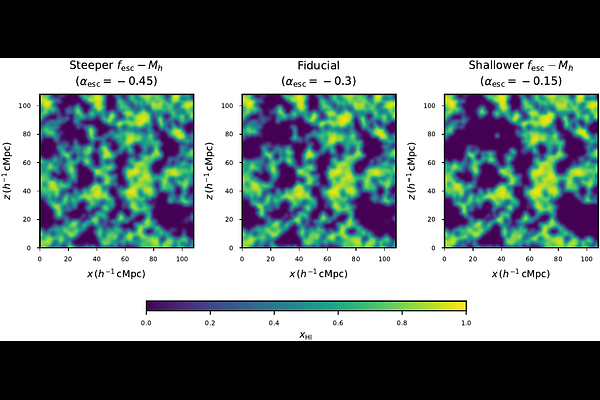
Abstract21cm radiation from neutral hydrogen serves as a direct probe of the Epoch of Reionization. However, both its detection and physical interpretation are severely hindered by contamination from astrophysical foreground emission and instrumental noise that are several orders of magnitude brighter than the signal of interest. A promising way to tackle these challenges is to cross-correlate the 21cm signal with other independent tracers of large-scale structure, most notably high-redshift galaxies. Besides validating putative 21cm detections, such joint analyses are expected to provide independent insights into the properties of ionizing sources and the evolving morphology of ionized regions during reionization. The 21cm signal, however, is intrinsically highly non-Gaussian, limiting the effectiveness of conventional two-point cross-correlation statistics, which capture information only up to the second order. In this work, we therefore investigate the utility of k-nearest-neighbour cumulative distribution functions (kNN CDF), which encode information from the joint clustering at all orders, as an alternative framework for probing 21cm-galaxy cross-correlations. Using self-consistently simulated mock 21cm fields and a catalog of line-emitting galaxies at z = 7, we conducted a proof-of-concept study comparing the kNN CDF formalism and the two-point cross-correlation approach. We find that the kNN CDF statistics outperform the two-point statistics in detecting 21cm-galaxy cross-correlations, even in the presence of instrumental noise and aggressive foreground filtering. Moreover, at a fixed global ionized fraction, it is even able to differentiate between reionization models that remain indistinguishable using two-point statistics. These results demonstrate the power and unexplored potential of exploiting higher-order statistics for extracting maximal information from 21cm-galaxy synergies.