APOE4 genotype and old age interact to impact cerebrovascular function, brain volume, and neuroinflammation in mice

APOE4 genotype and old age interact to impact cerebrovascular function, brain volume, and neuroinflammation in mice
Kehmeier, M. N.; Choi, Y. D.; Cullen, A. E.; Zimmerman, B.; Leonhardt, T.; Snyder, M.; Cleveland, T.; Setthavongsack, N.; Woltjer, R.; Pike, M. M.; Alkayed, N. J.; Walker, A. E.
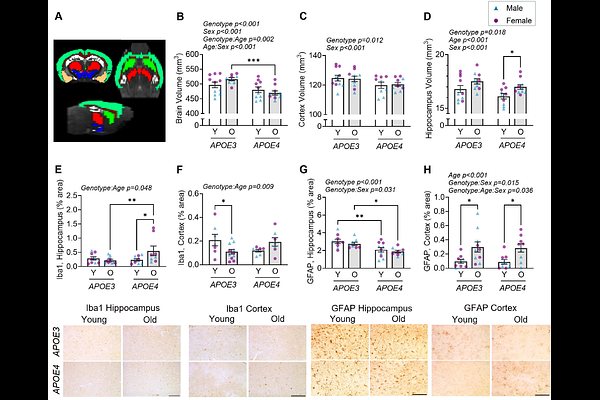
AbstractOld age and the apolipoprotein E4 (APOE4) genotype are two of the greatest risk factors for late-onset Alzheimer's disease (LOAD). However, the interaction between these is poorly understood, as most preclinical studies use young mice. Therefore, we assessed the interaction between APOE genotype and age across a comprehensive set of cerebrovascular and related outcomes. We performed in vivo imaging, ex vivo cerebral artery studies, behavioral tests, and molecular analyses in male and female homozygous APOE3 and APOE4 mice at ~6 months (young) and ~24 months (old). APOE4 interacted with old age to lead to deficits in brain volume and greater microglia content. Old APOE4 mice also exhibited greater cerebral artery vasoconstriction to endothelin-1 (ET-1) than old APOE3 mice, a response concomitant with age- and genotype-related differences in the expression of ET-1 receptors and endothelin-converting enzyme. While we found several interactions between age and APOE genotype, only age impacted cognitive function, cerebral artery endothelial function, and arterial stiffness. In summary, we found that brain volume, neuroinflammation, and ET-1-related outcomes were influenced by the interaction of APOE genotype and age, while other outcomes were affected only by age. As such, an altered ET-1 response and greater neuroinflammation may contribute to the increased risk for LOAD in APOE4 carriers.