Tear Proteomics Reveals RAGE and NLRP3 Inflammasome Pathway Activation in Lacrimal Glands of a Sjögren's Disease Mouse Model

Tear Proteomics Reveals RAGE and NLRP3 Inflammasome Pathway Activation in Lacrimal Glands of a Sjögren's Disease Mouse Model
Li, X.; Alba, M.; Fernandez, D. J.; Ramirez, A. V.; Abdelhamid, S.; Wang, C.; Edman, M. C.; Whitelegge, J.; Hamm-Alvarez, S. F.
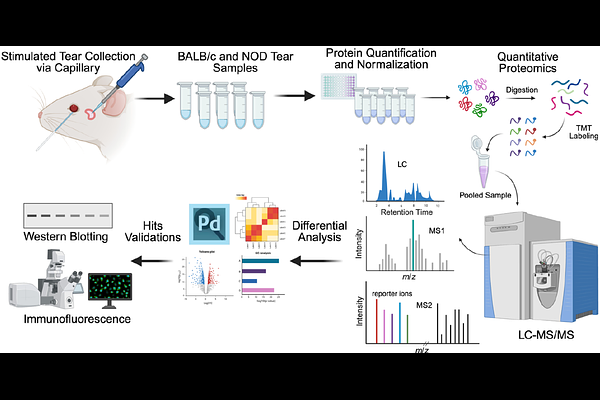
AbstractPurpose: To characterize tear proteome changes in male non-obese diabetic (NOD) mice with Sjogren's disease (SjD)-like autoimmune dacryoadenitis and determine whether identified tear proteins are associated with lacrimal gland (LG) pathogenesis. Methods: Tears were collected from 14-week-old male NOD mice and age-matched male BALB/c controls and analyzed by tandem mass tag (TMT)-based liquid chromatography tandem mass spectrometry (LC-MS/MS). Differentially expressed proteins (DEPs) were defined using adjusted P < 0.05 and absolute fold change > 1.5. Functional enrichment analysis was performed using Enrichr. Selected upregulated DEPs were further examined in tear and LG samples from independent mouse cohorts using Western blotting, immunofluorescence, and RT-qPCR. Results: A total of 142 proteins were quantified across all tear samples. Hierarchical clustering and principal component analysis (PCA) separated NOD from BALB/c tear proteomes. A total of 41 proteins were differentially expressed in NOD mouse tears (33 increased, 8 decreased). Increased tear proteins were enriched in immune and inflammatory responses, secretory compartments, RAGE receptor binding, glutathione metabolism, oxidative stress, and redox regulation. S100A8/A9, GSTO1-1, Gal-3, and pIgR/secretory component (SC) were increased in both NOD mouse tears and LG. In NOD LG, increased S100A8/A9 was accompanied by elevated RAGE, whereas increased GSTO1-1 was associated with increased NLRP3, cleaved caspase-1, cleaved gasdermin, cleaved IL-1{beta}, and increased Il1b, Il18, and Il18r gene expression. Conclusions: Male NOD mouse tears contain disease-related proteins reflecting pathological inflammatory and epithelial changes in the LG including increased RAGE signaling, NLRP3 inflammasome activation, and altered epithelial transcytosis.