Interpreting map-based $E$/$B$ spectral properties of CMB foregrounds

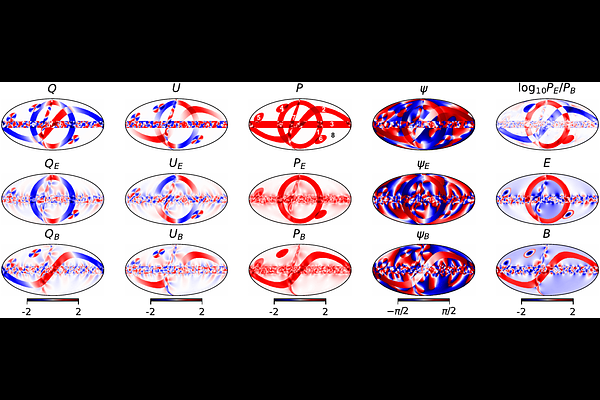
Interpreting map-based $E$/$B$ spectral properties of CMB foregrounds
Gilles Weymann-Despres, Léo Vacher, Michael E. Jones, Angela C. Taylor, Carlo Baccigalupi, A. J. Banday, Richard D. P. Grumitt, Nicoletta Krachmalnicoff
AbstractMap-space $E$/$B$ decompositions of linear polarization are attractive for foreground and CMB analyses because they isolate the $B$-family patterns that contaminate primordial tensor searches from $E$-family patterns that trace coherent Galactic structures. However, the $E$/$B$ transform is non-fully-local and induces apparent spectral complexity in projected fields even when the underlying sky is spectrally simple in $\underline{P}=Q+iU$. We quantify this effect for synchrotron emission. We introduce a complex-parameter description of the frequency dependence of $\underline{P}$, its spin-preserving projections $\underline{P}_E$ and $\underline{P}_B$, and the scalar $\underline{S}=E+iB$, using complex log--Taylor and moment expansions (with simple transformation rules under $E$/$B$ projection) and linking their coefficients to spectral-index variations, line-of-sight mixing, synchrotron ageing, and Faraday effects. Using a toy model and a PySM template, we find that scalar combinations, especially $|E|$ and $|B|$, acquire the largest induced complexity, while $\underline{S}$ is less affected but lacks a directly interpretable amplitude and angle. By contrast, $\underline{P}_E$ and $\underline{P}_B$ retain a clear geometric meaning and exhibit only moderate spectral distortions, while satisfying the closure relation $\underline{P}=\underline{P}_E+\underline{P}_B$ (which extends to all spectral orders in the moment formalism). Finally, with three frequency channels, we compare low-order spectral truncations and propose diagnostics to test whether the data favour a single power law in $P$ or independent power laws in $(P_E,P_B)$. This work is intended to be of practical relevance for both Galactic science and CMB $B$-mode analyses and lays the conceptual foundation for a series of papers applying the framework to observational data.