Radio sirens: inferring $H_0$ with binary black holes and neutral hydrogen in the era of the Einstein Telescope and the SKA Observatory

Radio sirens: inferring $H_0$ with binary black holes and neutral hydrogen in the era of the Einstein Telescope and the SKA Observatory
Ulyana Dupletsa, Simone Mastrogiovanni, Marta Spinelli, Tommaso Ronconi, Matteo Schulz, Riccardo Murgia, Jan Harms, Tessa Baker, Matteo Calabrese, Carmelita Carbone, Steven Cunnington, Ian Harrison, Konstantin Leyde, Dounia Nanadoumgar-Lacroze
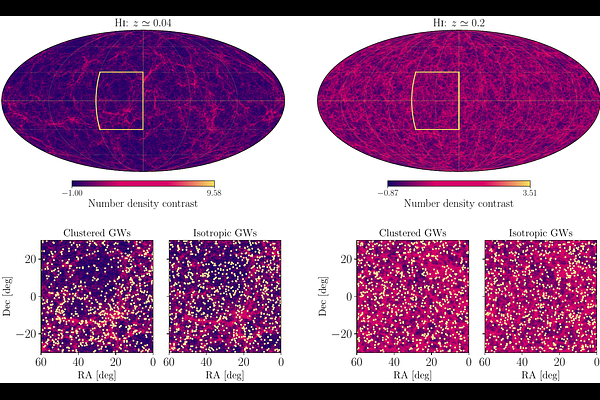
AbstractA new synergy between gravitational waves (GWs) and the study of the large-scale structure of the Universe is now emerging. Along this line of research, we combine simulated observations of stellar-origin black hole mergers and neutral hydrogen 21 cm line intensity mapping to probe the expansion rate of the Universe through the distance-redshift relation. GW signals from binary black holes provide direct distance information, while neutral hydrogen intensity maps offer a tomographic view of the large-scale structure of the Universe. Using the 3-dimensional density fields of hydrogen as a redshift prior for GW events, we explore a novel dark-sirens-like approach, here termed radio sirens, to measure the late-time expansion history of the Universe. We study the performance of the next-generation GW observatories, such as the Einstein Telescope, to ensure enough statistics and access to high-redshift data. On the other hand, future spectroscopic intensity mapping surveys with the SKA-Mid telescope are expected to trace the underlying dark matter distribution at large scales up to redshift $z\sim 3$. This combined methodology allows us to constrain the Hubble constant to $\sim 8\%$ precision, using around 3,000 GW events with signal-to-noise ratios greater than 150. This corresponds to an improvement of around $90\%$ compared to not considering the information from the neutral hydrogen maps.