Assessing planktivorous fish as vectors of a plankton parasite

Assessing planktivorous fish as vectors of a plankton parasite
Lampadaridis, N. D.; Herrera-Castillo, C. M.; Ebert, D.
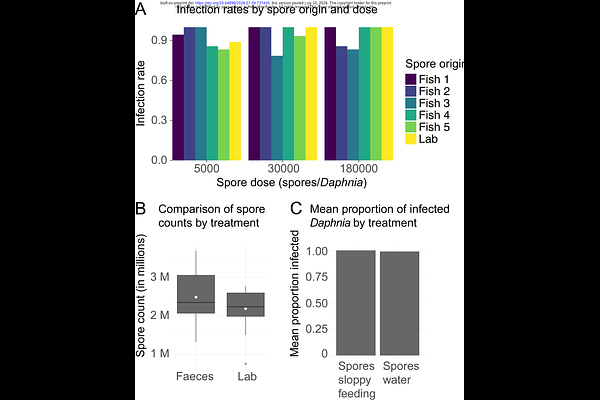
AbstractPredators are often considered regulators of disease in prey populations, a concept central to the "healthy herd hypothesis". This hypothesis suggests that by preferentially removing infected individuals, predators can reduce parasite prevalence. However, predators may also act as disease vectors, facilitating the spread of parasites. We investigated whether stickleback fish (Gasterosteus aculeatus) can act as vectors for the transmission of the obligate bacterial parasite Pasteuria ramosa to its Daphnia host, a widespread freshwater zooplanktor. We fed infected D. magna to sticklebacks, and subsequently analysed faecal samples for the presence, viability, and infectivity of parasite transmission stages (= spores). We recovered approximately 60% of the consumed spores from fish faeces and these spores did not suffer from reduced infectivity to D. magna. Additionally, spores associated with sloppy feeding did not reduce infection rates. Thus, consumption of infected hosts by fish does not eliminate the parasite, but in contrary, may contribute to the spread and persistence of P. ramosa in natural populations, potentially influencing parasite dynamics in natural freshwater ecosystems.