Evidence for the merger hypothesis in V4332 Sgr: a low $^{12}$C/$^{13}$C ratio and multiple outbursts

Evidence for the merger hypothesis in V4332 Sgr: a low $^{12}$C/$^{13}$C ratio and multiple outbursts
D. P. K. Banerjee, A. Evans, Watson P. Varricatt, N. M. Ashok
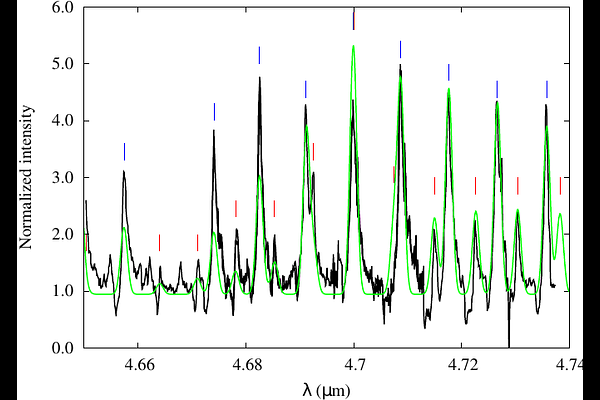
AbstractFollowing the detections of the first extragalactic ``Luminous Red Nova'' (LRN) M31 RV in 1989, and its first Galactic counterpart V4332~Sgr in 1994, there have been many discoveries of similar, or closely related, objects. They are important because they bridge the luminosity gap between the brightest novae and supernovae, a largely unexplored parameter space. The cause of eruptions in LRNe is still unclear, a stellar merger being the most favored mechanism. However, barring V1309~Sco, there has been no direct evidence for a merger in the other objects. Here we present strong evidence that V4332~Sgr was a merger event. High resolution infrared observations of the CO fundamental band show an unusually small $^{12}$C/$^{13}$C ratio of $3.5\pm1$. This indicates that a violent event had occurred, whose effects penetrated deep enough to allow CNO cycle processed $^{13}$C in the inner H burning shell to be brought to the surface. We rule out planetary ingestion, and propose that the eruption was due to a merger between V4332~Sgr and a companion star. It is shown that V4332~Sgr was likely surrounded by an edge-on disk before its eruption. If this disk was a flattened common envelope containing V4332~Sgr and a companion star, then a merger scenario would not be inconsistent. Furthermore, V4332~Sgr had multiple outbursts, previously unreported but an important piece of information, since multiple outbursts are a trait shared by many LRNe.